


For a business to grow in revenue and as a brand, they need a clear understanding of the fundamental of marketing. These fundamentals explain how a business attracts attention, creates interest, communicates value, and guides people from awareness to becoming customers.
Whether you are a small business owner or someone learning marketing basics for the first time, understanding these foundations helps you make better decisions about where to spend your time and budget.
What are the fundamental of marketing?
Many businesses skip marketing strategies and jump straight into campaigns without thinking about their audience, message, or customer journey. This is why marketing strategies often feel confusing or inconsistent. When you understand the core marketing fundamentals, you can build campaigns that are more targeted, cost-effective, and aligned with what your customers actually need.
At a basic level, these fundamental marketing principles guide how businesses can position themselves, how they reach people, and how to build long-term customer relationships:
1. Understand your target audience
Knowing who you want to reach, what problems they face, and what motivates their decisions. This shapes every message, offer, and channel you choose.
Example:


Poster 1: Generic copy
Poster 2: Targeted copy
A tuition centre that wants to increase enrolments first identifies who they are trying to reach. Instead of targeting parents in general, they focus on working parents who need flexible class schedules for their children.
With this clarity, the centre can adjust their poster’s copy to highlight what matters most to their target audience, such as “Flexible evening and weekend classes for your child,” rather than generic claims about quality tuition classes.
2. Defining your value proposition
Always give a reason to someone on why they should choose your product or service over your competitors. This is because when two businesses offer similar types of service, the value proposition becomes the primary factor that influences which business customers choose.
When you explain the benefits you offer, it often indicates that you understand your customers and are capable of solving their problems.
Example:
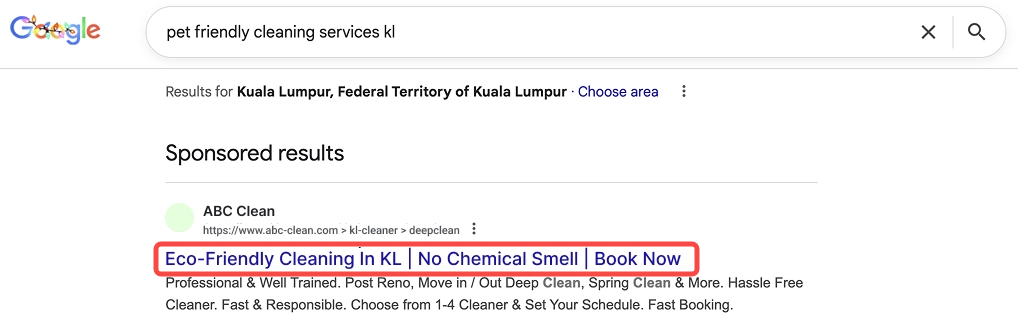
Ad copy 1
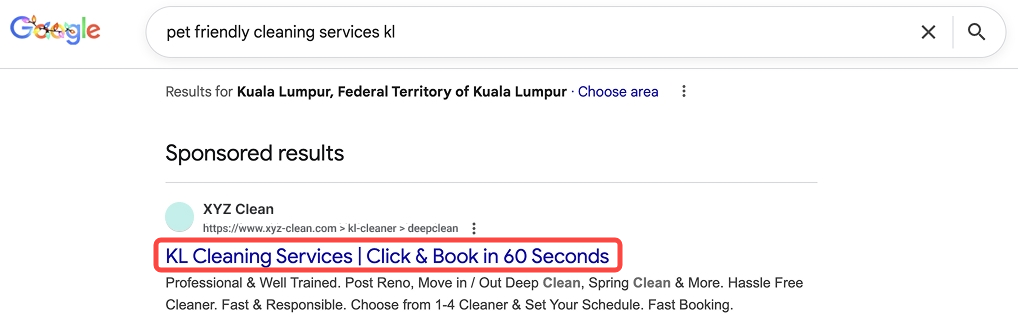
Ad copy 2
In the Google-sponsored search results above, the user searched for “pet friendly cleaning services”. The first ad highlights a clear and relevant value proposition, such as “Eco-Friendly Cleaning“, “No Chemical Smell”, which directly appeals to pet owners, families with young children, or anyone sensitive to strong chemicals.
The second ad uses a general headline like “KL Cleaning Services” and “Click & Book in 60 Seconds”. While it communicates convenience, it does not match the user’s intent or address their specific need for a pet-friendly or chemical-free cleaning service.
While the second ad may speak to users who search for cleaning services with a more general intent, the first ad is likely to receive a higher click-through rate and enquiries as it matches the intent.
3. Positioning your product or service
Define the space you want to occupy in the customer’s mind. This serves your business’s identity and helps people understand what makes you different from your competitors in the market, even if you offer a similar type of product or service.
This identity guides how you communicate, who you attract, and what people think of immediately when they hear your brand name. While a business can have different value propositions for different customer segments, all of them must still support one main positioning. Without this clarity, customers get confused, and the brand becomes harder to recognise or remember.
Example:
Malaysian bakery Tedboy positions itself as a Halal artisan bakery that focuses on freshly baked buns and pastries, free from artificial additives. This positioning appeals to customers who value halal-certified, healthier bread options and are willing to pay more for quality.
On the other hand, a well-known Malaysian brand like Rotiboy positions itself very differently. Instead of focusing on clean-label or artisanal baking, Rotiboy builds its entire identity around its signature freshly baked bun — a crispy, aromatic snack that is designed to be eaten hot, on the go, and enjoyed by the masses.
Its positioning centres on being an iconic, affordable, and accessible everyday treat, sold in high-footfall areas like malls and transit hubs, making it a familiar choice for families, students, and busy commuters.
While Tedboy positions itself as a neighbourhood artisan bakery, Rotiboy appeals to people who enjoy a fresh-from-the-oven signature bun that is affordable, familiar, and accessible in high-traffic locations. Both operate in the bakery industry, but their positioning — and the customers they attract — are completely different.
4. Communicating through the right channels
Choosing where to reach your audience is just as important as offering the value you give them. Whether through traditional, digital marketing, or a mix of both, each platform plays a different role in awareness, engagement, and conversion.
Example:
Wispr Flow markets to professionals, creators, developers, and users who prioritise faster workflows. Their marketing campaign strategy touches users across both traditional out-of-home campaigns and digital platforms such as social media, search engines and emails.
The sections below are to understand how this is done under each channel:
a. LinkedIn
Wispr Flow posts short video content featuring real users and creators to demonstrate how their product works.
This instantly shows how they can bring value to other vibe coders, developers, and someone who values work-life balance or work-life integration.
video from Tanay Kothari
Purpose:
For product awareness and educational purposes:
- Educate new audiences on their product
- Capture attention on how this product saves their time
- Build trust through real-life demonstrations
b. Google search visibility
When someone searches terms such as “speech to text AI free” and “AI voice dictation app”, Wispr Flow appears through organic search results, including SERP features like AI Overview.
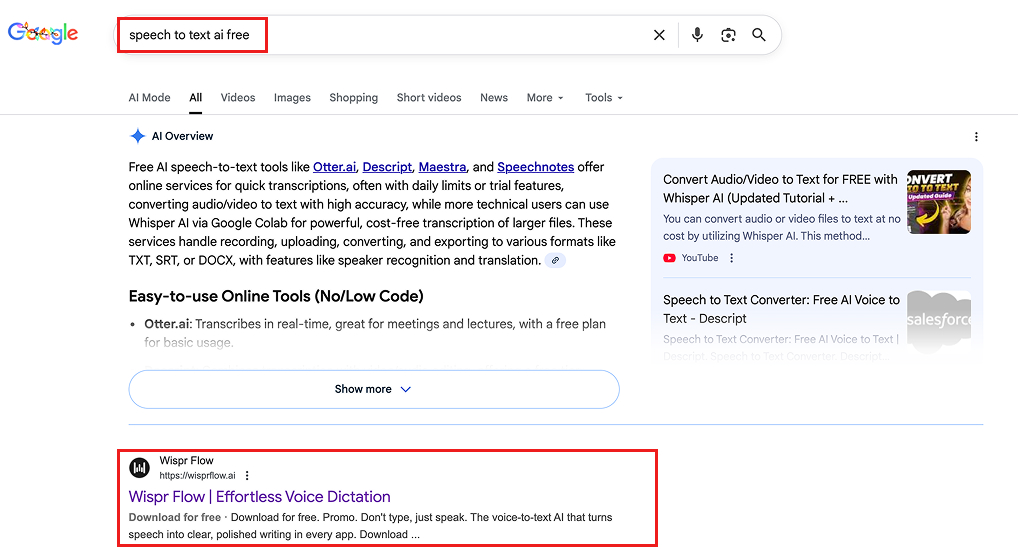
Search Engine Page 1
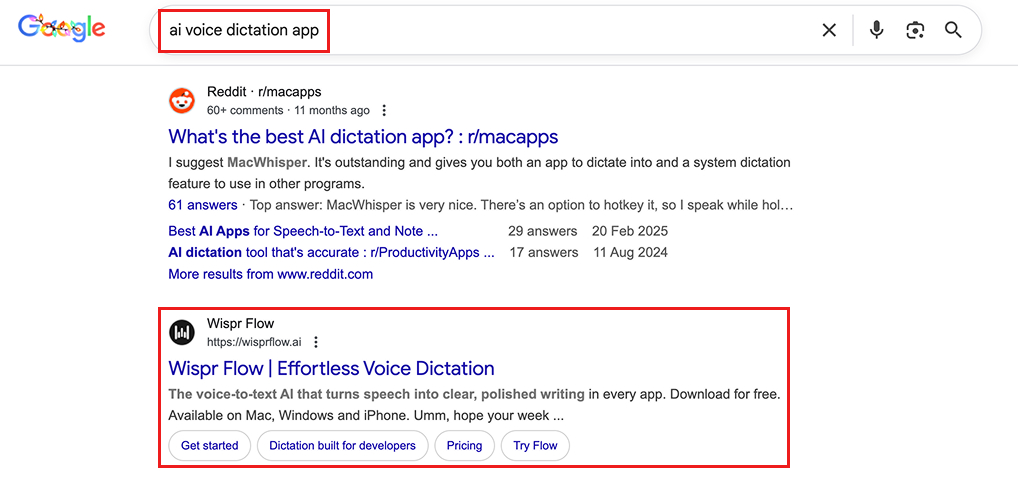
Search Engine Page 2
Purpose:
For high-intent acquisition:
- Capture users actively searching for an AI dictation tool
- Convert high-intent users who already understand their problem
- Positions Wispr as a leading product in the AI productivity and time-management category
c. Blog content marketing
Wispr publishes articles on their website to address topics users actively search for when looking for productivity solutions or information. This increases the chances of ranking their informational content on the first page of Google search results, including SERP features like AI Overviews.
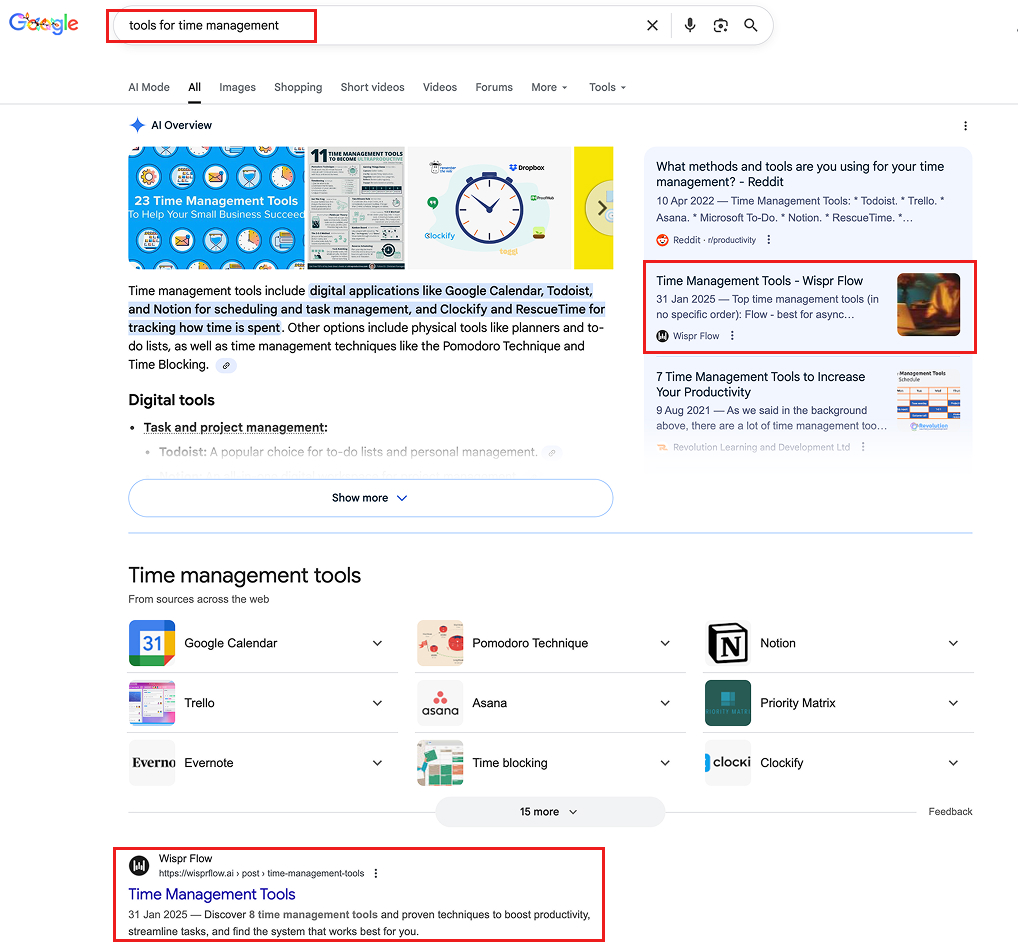
Search Engine Page 3
Purpose:
For organic traffic and high topical authority building:
- Educate users who are researching ways to save time through productivity tools
- Attract readers who are not yet searching for specific tools but are trying to increase productivity
- Build brand credibility and provide value to a larger audience through helpful, non-promotional content
d. YouTube Ads
Wispr Flow runs sponsored videos on YouTube main feed and pre-roll ads before your video to show how the product works and how the before and after on how someone works. These ads help users understand the product visually. And this is super important for any software products.
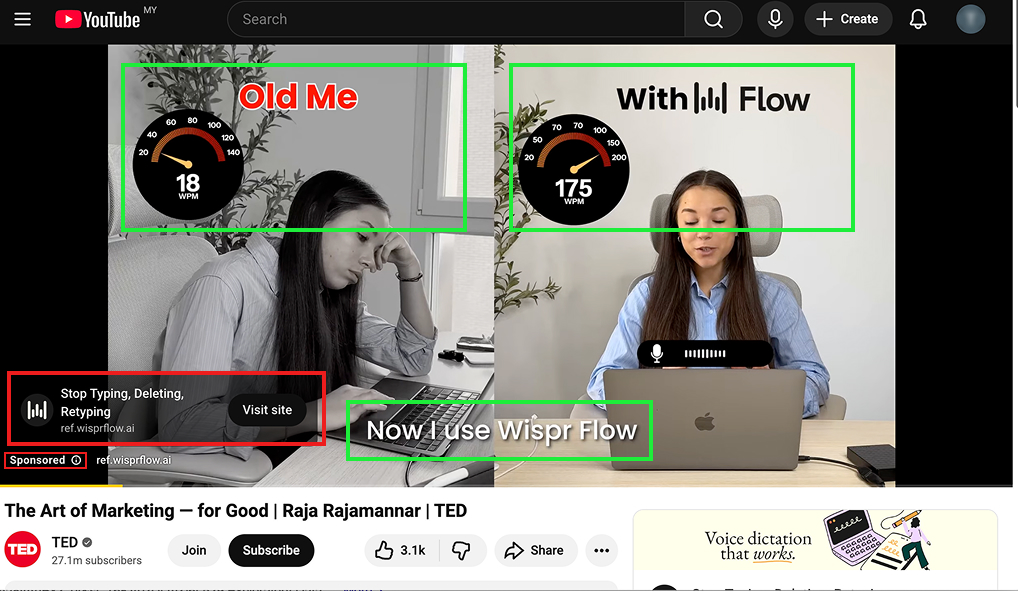
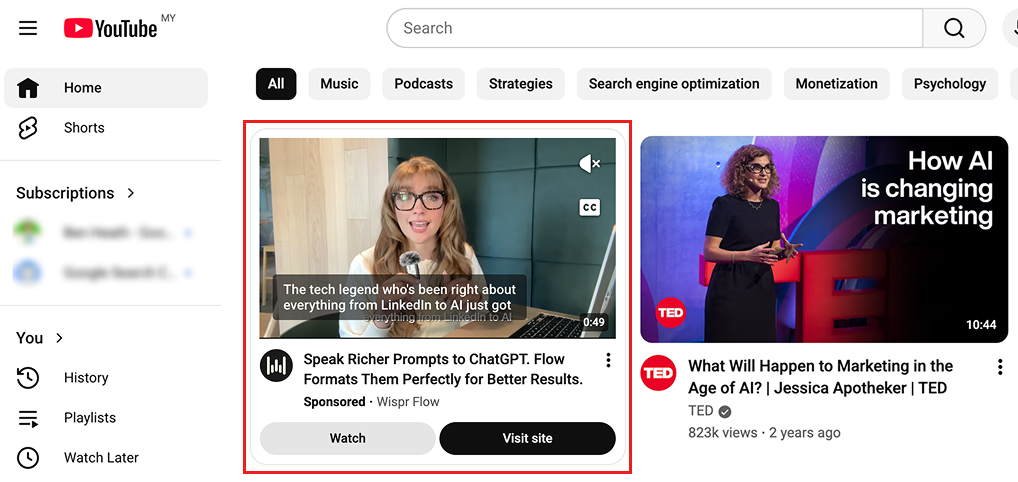
Wispr Flow sponsored ads
Purpose:
For product demonstration and retargeting:
- Demonstrate the product clearly
- Retarget users who have previously visited their website or ads
- Encourage sign-ups through visual storytelling
e. Email nurturing
After signing up from their website, Wispr help users quickly understand why the product matters and encourages them to experience the benefits immediately.
Wispr does this in two key ways:
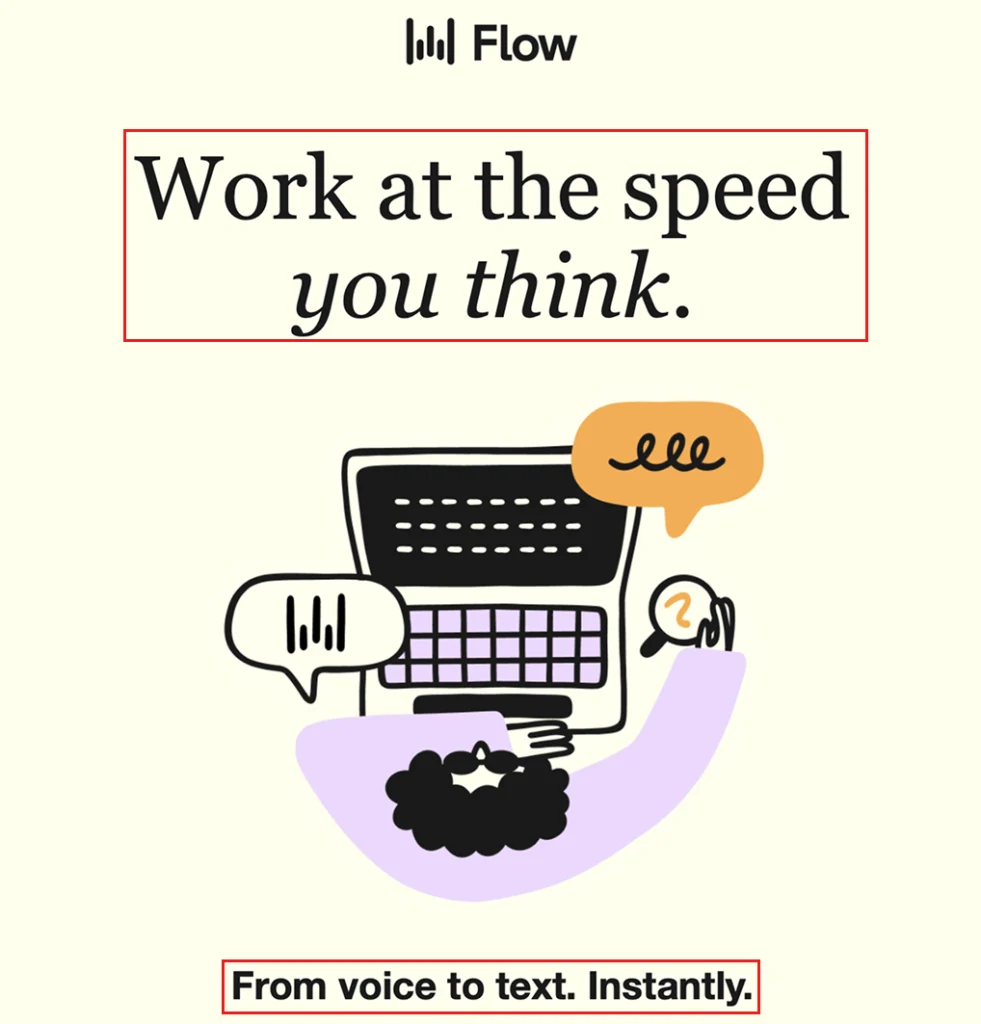
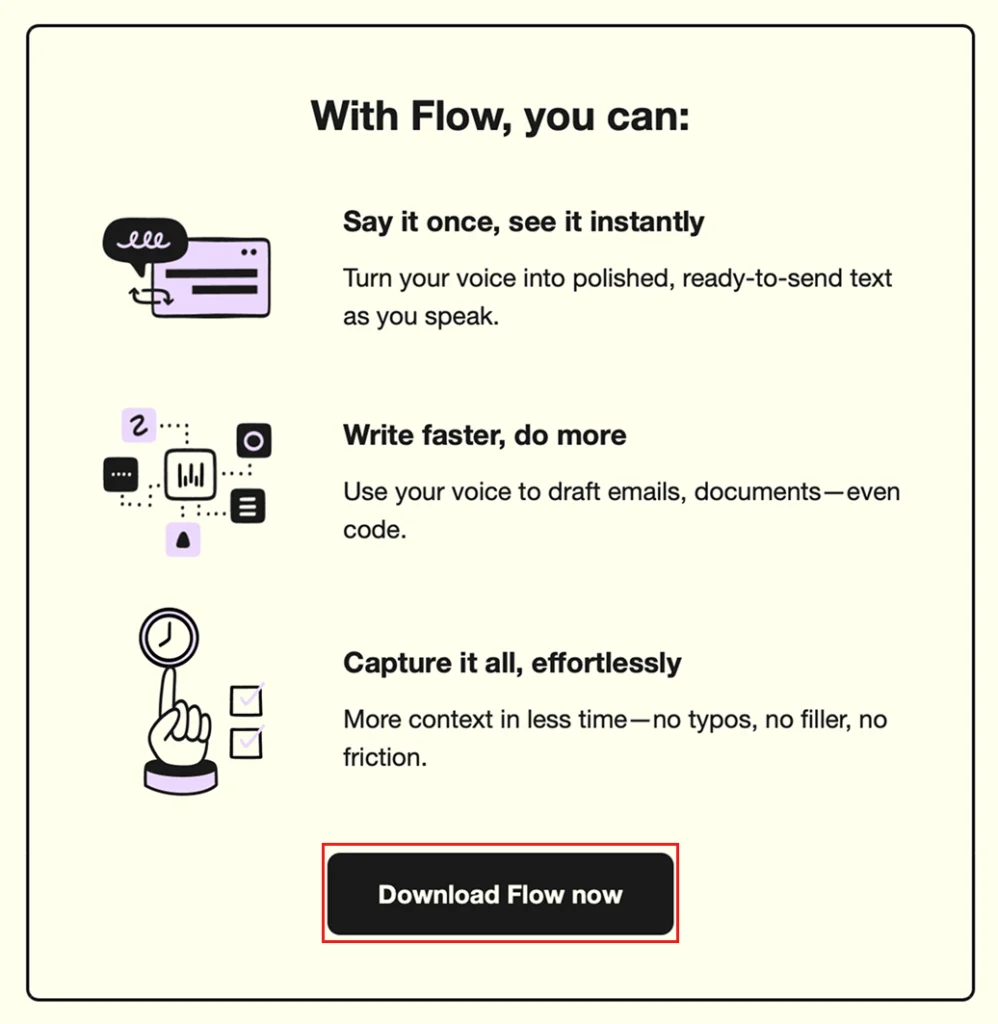
Onboarding email credit: Wispr Flow
The email opens with a strong headline, “Work at the speed you think“, and further explains what they mean through a subtext that shows how: “From voice to text. Instantly.”
This instantly frames Wispr as a productivity tool that helps you to work faster, instead of another AI app in the market, even before reading the entire email.
On the other hand, the content is structured around the outcomes users want, not the product’s technical capabilities. Instead of explaining how Wispr works, it shows what users gain when they use it.
By clearly communicating value before presenting the call-to-action, Wispr increases the chances that users download the app with the right expectations.
Purpose:
To drive early activation by helping users quickly understand and experience Wispr’s core value.
f. Billboard campaign
After signing up from their website, Wispr help users quickly understand why the product matters and encourages them to experience the benefits immediately.
Wispr does this in two key ways:
Purpose:
For high-level brand awareness:
- Reach people outside digital environments
- Build legitimacy and “brand presence” on a mass scale
- Signal that the product is mainstream enough to invest in offline advertising
5. Creating consistent messaging and content
Every piece of copy on your ads, social posts, pricing pages, sales conversations, etc., plays a role in shaping customer expectations and building trust.
When messaging stays consistent, customers know what to expect and are more likely to trust your brand.
Example:
If a gym promotes “no hidden fees” on their ads, but the sign-up form later lists multiple add-ons such as joining fees, maintenance charges, class access fees, etc., customers will feel misled and may abandon the sign-up process.
Even if the gym itself is good, inconsistent messaging creates confusion and erodes trust.
Consistent messaging ensures that what customers see in ads matches what they experience when signing up, helping to build credibility and long-term confidence in the brand.
6. Guiding clients.customers throughout the journey
Before someone buys, they move through a few natural stages: awareness, interest, consideration, decision, and purchase. Each stage requires different information, and marketing becomes far more effective when your message matches what the customer is ready for.
Awareness: The customer realises a problem or need.
Goal: Help them understand the problem and discover your brand.
Interest: They start exploring solutions and learning more.
Goal: Educate and build credibility.
Consideration: They compare options and evaluate value.
Goal: Answer questions, address objections, and provide clarity.
Decision: They’re ready to act but need confidence and convenience.
Goal: Provide strong CTAs and a smooth path to convert.
Purchase: They sign up or buy, and now experience matters.
Goal: Deliver a smooth onboarding and reinforce trust.
Understanding these stages helps businesses communicate the right message at the right time, making every marketing effort more efficient and increasing conversions without extra spending.
7. Measuring performance and improving over time
Track what works and what does not. Marketing becomes stronger when decisions are guided by data, customer behaviour, and ongoing testing. You can track user behaviour, user pathways in tools like Google Analytics, or even a short survey on how they find your product in apps’ onboarding screens, or during the checkout process.
Sometimes, measuring how someone finds you can also be a simple question asked during a product demo or sales call.
Why every business should understand marketing basics before running campaigns?
Businesses should understand marketing fundamentals before running campaigns because these basics help them:
- Identify the right audience
- Create stronger messages for copy
- Choose effective channels
- Improve conversions
Without this foundation, even well-designed campaigns fail to produce results.
When you clearly understand your audience, value proposition, positioning, marketing channels, and customer journey, every campaign becomes more focused, more efficient, and more cost-effective. Instead of guessing the strategy, a business will know exactly what to say, who to say it to, and where to reach them.
For businesses running ads, lead generation campaigns, or social media marketing, this understanding prevents common issues like poor targeting, inconsistent messaging, and wasted ad spend. It creates alignment across the entire customer experience.
By educating themselves on marketing basics first, businesses set a solid foundation for growth. And when these fundamentals are supported by the right tools — such as Leaf CRM, which can help to capture, organise, and follow up with leads — the campaign’s conversion rate and cost per lead can be significantly improved.
Traditional vs digital marketing: Which strategy is more effective for today's business?
Digital marketing is generally more effective in modern marketing because it offers better targeting, faster data, and measurable results. However, traditional marketing still plays an important role in brand awareness, local reach, and trust-building. The most effective strategy is usually a mix of both, depending on the audience and business goals.
Most businesses now use digital channels to reach people online, track performance, and optimise campaigns in real time. But traditional marketing, such as billboards, print ads, and physical brochures, continues to work well for mass awareness, local communities, and industries where offline presence still matters.
A balanced strategy works best: digital for precision and conversions, traditional for credibility and reach.
| Factors | Traditional Marketing | Digital Marketing |
|---|---|---|
| Reach | Strong local or mass reach (billboards, newspapers, radio) | Global, targeted reach |
| Speed | Slow to launch and update | Instant launch, real-time optimisation |
| Cost | Higher upfront cost, less control | Flexible budget, cost-effective for SMEs |
| Targeting | Broad but less precise | Highly specific (interests, behaviour, intent, geographical location) |
| Measurability | Hard to track accurately | Detailed analytics and conversion tracking |
| Audience Behaviour | Works for older, offline, or local audiences | Works for digital-first users, younger demographics |
| Purpose | Builds trust and brand presencedson | Drives leads, conversions, and measurable growth |
| Best Use Case | Awareness, credibility, local presence | Lead generation, retargeting, and online sales |
Traditional marketing still works for businesses that rely on trust, locality, or mass visibility. But digital marketing gives businesses more control, data, and flexibility in their marketing campaigns.
The most effective approach today is often an integrated strategy, using traditional channels to build awareness and digital channels to capture intent, nurture leads, and convert customers.
How do traditional and digital marketing work together strategically?
Many businesses believe they must choose between traditional and digital marketing, but in reality, the most effective strategies use both. Each channel plays a different role, and when combined, they reinforce one another. Traditional marketing builds familiarity and broad visibility, while digital marketing captures intent, nurtures leads, and drives measurable results.
Most customers today move freely between online and offline touchpoints. They may see a billboard on the road, read reviews online, watch a video demo, and finally convert through an ad or website. This means businesses get the best results when both approaches work together across the full customer journey.
Why is combining both so effective?
1. Traditional channels create broad awareness
Billboards, printed materials, events, and signage introduce the brand to people who may not be actively searching yet. These channels build recognition and trust.
2. Digital channels capture interest and drive action
Search ads, social content, email, and websites give customers a place to learn more, evaluate options, and take the next step.
3. Offline trust + online convenience = higher conversions
When people recognise a brand from offline visibility, they are more likely to click on its ads, visit its website, or engage with its digital content. Consistency across channels strengthens credibility and builds strong brand loyalty.
4. Each channel supports different stages of the customer journey
Offline touchpoints are strong at awareness; digital performs best at interest, comparison, and conversion. Together, they form a smooth path from discovery to purchase.
5. Integrated marketing reduces wasted spend
Instead of relying on a single channel, businesses diversify their touchpoints and maximise visibility in places where their audience naturally spends time.
When traditional and digital channels work together, businesses get stronger brand recall, more qualified leads, and a more seamless customer experience.
How marketing fundamentals shape the entire customer journey
Marketing fundamentals influence how customers discover your brand, evaluate your offer, and eventually decide to buy. When a business understands its audience, value proposition, positioning, channels, and customer journey, every stage becomes clearer and more intentional.
Strong fundamentals help attract the right people at the top of the journey, guide them with the information they need as their interest grows, and support them through the decision-making process. Instead of leaving the journey to chance, businesses can create a smooth, structured path that moves customers from first contact to long-term loyalty.
These fundamentals also determine how effectively a business captures interest, follows up with potential customers, and prevents sales opportunities from slipping through.
Conclusion
In short, the key to successful marketing is getting the fundamental right. That includes understanding your audience and customer needs, defining your value, positioning your brand, choosing the right channels, and mapping the customer journey. This gives your business a stronger marketing objective for every campaign you run.
Marketing fundamentals shape not just how people find you, but how they move forward with you. A business that gets this right gets a high-performing campaign, improves lead conversions and build stronger relationships with those who choose your brand, and those who remember your brand.
Start with the basics, build your strategy around them, and your campaigns and customer service will become more effective and easier to manage.