


Insurance lead generation is how agents find new people to sell policies to. This process can be through ads, referrals, search, or buying leads from a vendor.
A lead comes in at 9PM from a Facebook ad. It appears in the team’s inbox, but no one is assigned to it. Two agents see the new lead, and both reach out, giving the prospect a confusing first impression.
The opposite can happen too. Both agents can see the inquiry, but each assumes someone else will handle it. And ends up, no one follows up.
In this article, we will walk you through strategies to get insurance leads, what each lead costs, and the follow-up habit that can win a deal.
Key Takeaways
- The main ways to get insurance leads:
- Referrals
- Facebook and Instagram lead ads
- Google search ads
- SEO
- Social media
- Networking & partnerships
- The one thing that matters most:
- Contact every new lead within the first 5 minutes.
What is insurance lead generation?
It’s the work of finding people who might buy a policy and getting their details so an agent can follow up. It has two halves: getting the lead and working it.
A lead is a person with a reason to buy. Someone who just bought a home needs home insurance. A business owner who hires staff may want group health cover. Both are leads for an agent.
Leads differ in quality. A raw lead is just a name and a phone number. A quality lead shows a clear need, like an auto insurance quote for a car someone bought last week. The clearer the need, the more likely the lead ends in a sale.
Most agents put their effort into the first half: how to generate insurance leads from ads, referrals, or vendors. The second half decides who gets the sale. A lead that waits hours for a call often buys from someone else.
How to get insurance leads: 7 methods
Each of these insurance lead generation ideas has its own trade-off in cost, effort, and lead quality.

| Strategy | How It Works | Who It Suits | What Goes Wrong |
|---|---|---|---|
| Referrals | Happy clients pass your name to friends and family who need cover. | Agents on a tight budget and experienced agents who carry high trust from clients. | Time-consuming and highly dependent on client relationships and word-of-mouth. |
| Facebook and Instagram Lead Ads | Meta shows your quote form to people in your area, and they send it with one tap. | Agents with an advertising budget who want a steady flow of leads. | May attract junk leads and users with relatively passive intent. |
| Google Search Ads | You bid on searches like "car insurance quote" and pay for each click. | High-budget agencies, agents with the budget to target high-intent searches, and fast-responding teams. | High competition with big companies and sponsored content. |
| SEO | Your own pages rank on Google for local insurance searches, with no cost per click. | Agents playing a long game in one town or niche. | Time-consuming and relies heavily on content creation and SEO management to build credibility and trust. |
| Social Media | You post tips and videos, and followers message you when they need a policy. | Agents who want to build an online presence and personal branding online. | Requires consistent content and time to build an audience and trust. |
| Networking and Partnerships | Realtors, mortgage brokers, and car dealers send you clients, and you send them yours. | Agents who are good in person. | Takes months and sometimes luck to build. |
Referrals
If your agency runs on a tight budget, or you’ve spent years earning your clients’ trust, referrals fit you best. You spend almost nothing. A happy client gives you a name. That person picks up your call because a friend sent them. In Canadian Underwriter’s 2026 survey of 169 Canadian brokers, 71% said asking clients for referrals is the best way to get new leads. Among brokers with 16 to 30 years in the job, it was 90%.
The downside is time. Every referral rests on a client relationship you built and on word-of-mouth you can’t control. You can ask for a name, but you can’t make a client talk about you. So you stay in touch, handle each claim well, and wait for the next name.
Facebook and Instagram Lead Ads
Got some advertising budget and want leads to show up every week? Lead ads deliver that steady flow. You set a daily spend, and Meta shows your form to people in your area. New names keep landing as long as the money runs.
The quality is another story. Finance and insurance ads on Meta get a 0.98% click-through rate, one of the lowest of any industry. Many of those clicks turn out to be junk leads, and few of the people behind them plan to buy. Their intent is passive at best. Most people open Facebook and Instagram to relax, not to shop for a policy. Meta fills in their name and phone number for them, so one tap sends the form. By the next day, some have forgotten you.
Google Search Ads
Search ads work for agencies with deep pockets that want to show up on high-intent searches. A person who types “car insurance quote” wants a price today. Your ad puts you in front of that person at that moment. That person will ask other agents, too. So the win goes to teams that respond fast and call back first.
The hard part is the crowd you bid against. Big carriers and their sponsored ads fight for the same clicks. WordStream’s 2025 benchmarks put finance and insurance search ads at $83.93 per lead. Progressive alone spent almost $3.5 billion on advertising in 2024. Their ads sit at the top of the page. A small agency can burn its budget before it wins a single lead.
SEO and local content
SEO pays off for firms that reach the top of Google. Once your page ranks for “car insurance agent near me,” it brings in leads with no cost per click. People who search that phrase are ready to talk.
Reaching the top takes a long time. You need steady content and careful SEO management before Google and your readers see you as credible and trustworthy. In a 2025 study, Ahrefs tracked 1 million new pages. Only 1.74% reached Google’s top 10 within a year. Ahrefs also found that 72.9% of the top 10 pages are more than three years old. So you write useful local pages, update them, and earn links long before the leads show up.
Social media
Social media suits agents who have already gained online presence. A post costs you nothing but time. Over months, your videos and tips show followers how you work and what you know. Some of them will message you when they need a policy.
The real cost is consistency. Brands on Instagram post one to two times a day on average, but an agent with clients to serve cannot keep that pace for long. So the audience grows slowly.
Networking & Partnerships
Realtors, mortgage brokers, and car dealers meet people who just bought something insurable. Every week. You send them business, and they send you business. No platform takes a cut. This suits an agent who is good in a room. It also runs on a clock you cannot speed up. The partner you want guards a book that took them a decade to build. They will not hand you a slice in week one.
Likewise, your arena counts. Even in the same insurance business, strategies play different roles across fields. Life insurance lead generation often leans on referrals and social ads. Commercial insurance lead generation leans on partnerships because you are chasing a business owner.
If you want a shortcut, here is one rule that sits above all six: whichever strategy you pick, the lead is worth nothing until a person contacts it. That is where the money leaks.
Why speed wins in insurance
|
“Leaf CRM saves us hours every week. We can immediately see which campaigns are actually working, then adjust our targeting and focus on bringing quality leads.” —-Pah Phin Shang, General Manager from GMH Consultancy Service Sdn. Bhd. |
What fast follow-up looks like (with Leaf CRM)
Here is the lifespan of a lead, from first click to first call.
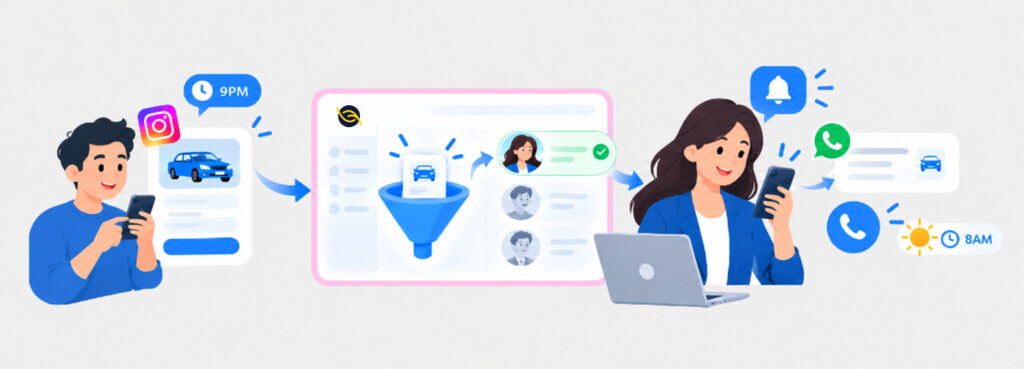
It is 9PM. Someone clicks your Instagram ad and asks for a car insurance quote. Leaf catches the form the second it lands and hands the lead to the agent whose turn it is. Her phone buzzes. She reads the name, sends a WhatsApp message in four minutes, and calls at 8AM. Four other agents open their inbox at nine and find a person who already has a quote.
Two things make that work.
First, catching. A lead only moves fast if the system grabs it the moment it arrives, not when someone opens a spreadsheet on Wednesday. Instant lead assignment rules hand each new lead to a named agent in seconds, and Away Mode skips agents who are off shift.
Second, reaching. Email alone loses this race. The agent needs a push alert on the phone in her pocket and a way to answer without saving the number first. Leaf pushes the alert to her phone and lets her open a WhatsApp thread with a template.
You can catch every lead and get it to an agent in seconds with Leaf’s lead assignment, and the free plan covers up to three agents.
Lead generation for insurance agents: best practices
Pick a lead generation method
Start with one or two of the six methods above, not all six. Pick by budget, time, and strengths. Short on cash? Referrals and networking cost little but take patience. Have an ad budget and a fast team? Google Search Ads bring people ready to buy. Your product line matters, too. Life agents lean on referrals and social ads. Commercial agents do better with partnerships.
Set a rule for responses
Pick a response time for every new lead and make it a team rule. Aim for five minutes. In a Lead Response Management study, teams that called a lead within 5 minutes were 21 times more likely to qualify it than teams that waited 30 minutes. Give each lead to one named agent, with a backup. Then check everyone’s response time weekly.
Follow up consistently
Many agents give up after one or two calls. Yet 8 in 10 sales need five or more tries for follow-ups. So plan six or seven touches over two weeks. Start with a call, then switch to WhatsApp and email. Make each touch add something new, like a quote comparison. If the lead stays silent by day 16, send a breakup message and close the file. Use these scripts to [follow up with leads] at every step.
Track which source your sold policies came from.
Judge each source by the policies it sells, not the leads it brings in, since a cheap source can still cost more per sale. Keep tracking after the sale, too. In a study of a German bank’s customers, referred customers left about 18% less often, and the gap held for almost three years.
Handle nights and weekends on purpose.
The insurance industry mainly falls into the category of B2C. Therefore, most insurance leads arrive outside office hours, and that is when they go cold. However, with the help of an automated lead management tool, you can still have a pleasant weekend while your competitors are striving to capture the potential leads manually.
What to look for in a lead follow-up tool
Here is a checklist that can help you decide which tool to use:
- Does it catch leads from your ad and form sources automatically?
- Does it get the lead to an agent in seconds and skip agents who are off?
- Does the agent get a phone alert or just an email?
- Can the agent reply on WhatsApp without saving the contact first?
- What does it cost per person, and is there a free plan to test it?
Two kinds of product answer that list. An agency management system handles ratings, policies, renewals, and commissions. It suits an agency with a big book to service. A lead-and-follow-up CRM catches new leads and gets an agent talking fast. It suits an agent who keeps losing the 9pm ones.
Leaf CRM is the second kind. It catches leads from Facebook, Instagram, TikTok, Google Ads, and website forms, then assigns each in seconds: by turns on the free plan, or by your own rules on Pro. Away Mode skips agents who are off. Agents get a phone alert and WhatsApp templates. Leaf does not generate leads or sell lists. It has no quoting, CPQ, or policy management, so it will not replace an agency management system. Leaf’s insurance lead generation software is free for three agents, then $32 per agent per month.
Conclusion
Now, you have learned how to generate insurance leads. Getting them is half the job. The half most agents lose is the follow-up.
So what you have to do is (1) pick one or two strategies, (2) contact every new lead in minutes, and (3) add a third source only once you are fast on the two you have.
A solo agent closing five referrals a month by phone doesn’t need software yet. Once leads start coming from ads and forms at all hours, that changes.
Book a demo with us if interested. In Leaf CRM, the Starter plan includes basic lead distribution for up to three salespersons; you can start free with no credit card.
Frequently asked questions (FAQs)
What is lead generation in insurance?
Lead generation in insurance is the process of locating, attracting, and capturing prospective clients who are interested in purchasing insurance. The primary purpose is to provide a consistent pipeline of prospects for insurance agents, brokers, and carriers. For a small agency, that means a steady list of people to call each week.
How much does it cost to buy insurance leads?
Prices depend on the type of lead and how old it is. ActiveProspect puts shared web leads at $10 to $45 each. For health insurance, Aged Lead Store lists exclusive leads at $40 to $100 or more, and aged leads at $0.15 to $5. The older the contact details, the lower the price.
What is the best way to generate insurance leads?
Referrals convert best, paid ads scale fastest, and fast follow-up beats the source either way. A referred prospect already trusts you, so the first call goes easier. Search ads bring volume as soon as you fund them. Whatever the source, the agent who calls first usually wins the sale.
How fast should you contact a new insurance lead?
Within five minutes. The longer you wait, the higher the likelihood the prospect has already spoken with your competitors. The MIT Lead Response Management study found that the odds of qualifying a lead drop sharply after the first five minutes.
Are bought insurance leads worth it?
Yes, if you judge cost per sale, not cost per lead. Exclusive Medicare leads at $20–$40 closing 8–15% cost $200–$400 per client, while life clients can reach $2,000–$3,000. Call first, and even new agents build a pipeline faster than starting from scratch.
How can technology like AI and automation help with insurance lead generation?
Automation closes the response gap. The odds of qualifying a lead drop 21 times between a five-minute and thirty-minute callback. AI adds lead scoring and after-hours routing. Meanwhile, McKinsey reports 10–20% gains in agent productivity with AI. The technology stops you from losing them.
How does Leaf CRM enhance insurance lead generation efforts?
Leaf CRM converges leads from ads, walk-ins, events, and referrals into one system and builds campaigns by policy type. It can send each lead to the right agent with rules (Pro plan), so first contact happens in seconds rather than days. Agents get a phone alert for every new lead.

An SEO content writer and a researcher focusing on CRM, digital literacy and AI literacy.