


Lead nurturing means staying useful to someone who is not ready to buy yet, so that you are the one they call when they are. Most guides on this will tell you to build an automated workflow. In this article, I will break down what it is, how to carry out, and when and why you need automation software to assist your lead nurturing.
Key summary
- What it is: A sales process for sales reps to build relationships with leads.
- The rule that matters: Nurturing is about being relevant at the right time, not about sending more messages.
- What to do first: Identify qualified leads and assign them to available reps.
What is lead nurturing?

Lead nurturing is the process of building and maintaining relationships with prospects (leads) through the sales funnel. Its ultimate goal is to close the deals smoothly. Instead of chasing or sending the same message on a timer, an effective lead nurturing campaign requires delivering relevant insights tailored to the buyer’s exact situation and pain points.
There are two conditions to make a lead nurturing campaign work:
- Relevance: the information is relevant to the leads;
- Timeliness: the information arrives when it is useful.
Most lead nurturing programs fail due to the lack of follow-up. For instance, a B2B software prospect requests a demo on Monday morning. The salesperson waits until Thursday afternoon to reply, but the prospect has already bought from a faster-responding competitor.
What lead nurturing is not
There are three other terms that salesperson(s) often mix up: follow-up, engagement, and qualification.
- Follow-up is the quick next step you take to keep the conversation alive.
- Engagement is the feedback you get that proves the prospect is actually listening.
- Qualification decides if the prospect is a good match for what you sell.
A simple example: a prospect downloads your guide, you text them to connect (follow-up), they reply saying they need help immediately (engagement), you verify they can afford your service (qualification), and you text them relevant case studies over the next month until they are ready to sign the contract (lead nurturing).
The stages of lead nurturing
The lead nurturing process consists of 4 stages. From the prospects’ side, they start with awareness and interest, and then after consideration, they make final calls. On the other hand, a sales team goes from sizing up the lead to closing the deal. Your job at each stage is to match what the buyer needs right then.
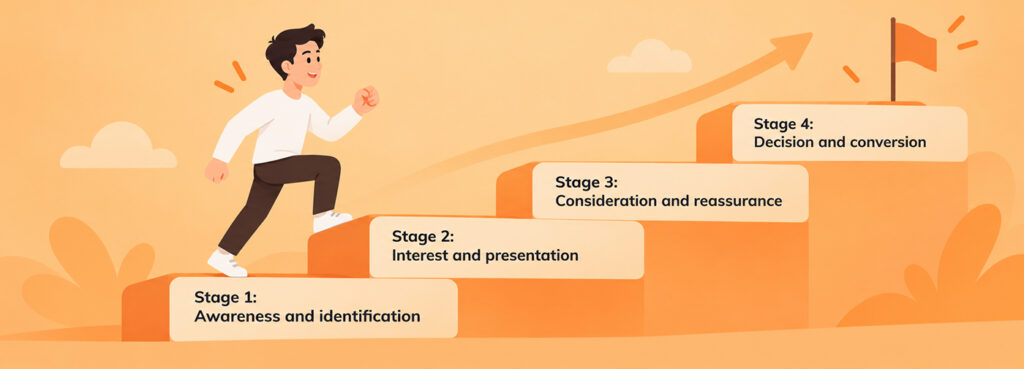
Stage 1: Awareness and identification
The buyer has noticed a problem. They may not know a product like yours exists yet. So don’t pitch. Teach them something useful about their problem.
While you do that, check whether they are worth your time. Ask about their need, budget, who signs off, and how soon they want it fixed. A lead that fails these checks goes on a slow list. A lead that passes moves to Stage 2.
Stage 2: Interest and presentation
Now the buyer wants to know what you offer. This is when you show it. Keep it tied to the problem they told you about in Stage 1. A clinic owner who complained about no-shows wants to see your reminder feature. They do not need your full feature list.
Stage 3: Consideration and reassurance
The buyer is comparing you with two or three others. They have doubts, and most won’t say them out loud. Price is the usual one. “Will my team actually use this?” is another.
Your job is to bring those doubts up before they do and build trust. Show a customer like them. Offer a trial or a demo with their own data. Put the cost next to what the problem costs them now.
Stage 4: Decision and conversion
This is the stage where you convert a potential customer to an actual buyer. The prospect is ready to choose and make the final decision. Find out who else has to say yes, such as a partner or finance. Settle the terms. Clear the last small worry. Then make the next step easy: one link, one form, one call.
Lead nurturing doesn’t end at closing deals. After they sign, walk them through setup. A smooth first week keeps them from regretting the purchase.
Keeping track of which stage each lead is in gets harder as your list grows. A CRM with instant lead assignment gives every new lead an owner the moment it comes in. With custom pipeline stages, you can set up these four stages to match how your team actually sells.
Building a lead nurturing strategy in 5 steps
Here are five steps in order for a successful lead nurturing campaign. Each one depends on the one before it.
1. Pick the leads worth nurturing.
You can’t nurture everyone. Keep a lead if it fits your ideal customer and has replied, clicked, or asked something in the past month. Let it go if it has no budget, no need, or has ignored you for months. Letting go doesn’t mean deleting. Move it to a “maybe later” list and stop setting reminders.
2. Assign an owner and a date.
A lead with no owner belongs to nobody. A lead with no date gets called “sometime,” which means never.
So each lead gets one name and one date. The owner is the rep who calls. The date is when the next contact happens. Nothing else is needed to start.
Speed matters most at the start. Harvard Business Review found that firms that replied within an hour were about seven times more likely to qualify the lead than firms that waited even one more hour. Put the first date on the same day.
3. Decide what to send.
Every message should give one thing and ask one thing. The thing you give fits their stage. Early on, that’s a tip or a short guide. Later, it can be a case study from their industry, a price breakdown, or an answer to the doubt they hinted at. The thing you ask is one easy question they can answer in a line.
Write five or six of these ahead of time, one or two per stage. Then reps edit instead of starting from a blank screen.
4. Write down your follow-up schedule.
Everyone follows up when things are quiet. The rhythm breaks when you get busy, and that’s also when leads go cold.
Pick a simple schedule and put it on paper: same day, day 3, day 7, day 14, then once a month. Put this rule where the whole team can see it, in your CRM software or a shared sheet. If it lives only in someone’s head, it will slip the first week that person is swamped.
5. Review the lead list.
A list full of dead leads hides the live ones. Once a month, spend 30 minutes going through it.
Ask one question of each lead: has anything changed? If they replied, move them forward. If they went quiet after three or four tries, move them to the “maybe later” list. If they bought from someone else, send a short, friendly note and set one check-in for six months out.
Eight lead nurturing examples to follow
Below are 8 common lead nurturing scenarios that a sales team may encounter. Among them, pay more attention to two situations: a lead who asked for a price and vanished, and the lead who bought from a competitor. These two are the most difficult ones to deal with.
| The situation | What to send | When | Channel |
|---|---|---|---|
| Asked for a price, went quiet | A short note answering the objection they did not say out loud, plus one question. | 3 days, then 2 weeks | The channel they used |
| Said "Not right now." | Ask when to come back, then actually come back on that date. | On the date they gave you | Phone or WhatsApp |
| Downloaded something, never replied | One useful thing related to what they took. No pitch. | Within 48 hours | |
| Went cold after a demo or site visit | A plain check-in that gives them an easy way to say no. | 1 week, then 1 month | Email or phone |
| Bought from someone else | A note wishing them well and asking to check in later. | Immediately, then 6 months | |
| Old lead, no contact in 6 months | A reason to talk that is genuinely new, e.g., a change in price, product, or rules. | When you have real news | Email or WhatsApp |
| Existing customer who could buy more | Something relevant to what they already bought. | After they have had time to use it | Phone or WhatsApp |
| Referral who has not responded | Mention the person who referred them in the first line. | 2 days, then 1 week | The warmest channel available |
If you have encountered these situations, the following eight lead nurturing strategies will guide you on how to handle them.
Raise price concerns after a quote
Silence after a quote usually means the price raised a doubt the lead never said out loud. Maybe it looked high, or they couldn’t see what they’d get for it.
So, open with that worry, not “just checking in.” For example: “Some people find our quote higher than others. Here’s what the difference pays for.” Then ask one question: “Is price holding you back, or timing?”
Ask “not now” leads for a callback date
“Not right now” is about timing. It isn’t a no. Ask for a date: “When should I come back to you? Next month, or after your busy season?” Write the date down and call on that day. Start the call with a reminder: “You asked me to call in March.” Most reps forget to follow up, so calling when you promised makes you stand out.
Follow up on downloads within 48 hours
A download means they care about the topic. It doesn’t mean they care about you yet. Within 48 hours, send one thing that builds on what they took. If they grabbed a pricing guide, send a short example of how a similar business set its budget. Leave the pitch out. End with an easy question: “Did the guide answer what you were looking for?”
Get a confirmation after leads go quiet
Leads often go quiet after a demo because saying no feels awkward. Make it easy for them. A week later, write: “I understand you’re comparing options. If this isn’t a fit, just tell me and I’ll stop following up.” Leads often answer a line like that, yes or no.
If they still don’t reply, try once more at the one-month mark, this time by phone.
Check in six months after losing a deal
Most reps delete this type of lead. However, you won’t know if their new supplier will let them down with a late delivery, a slow reply, or a price rise. When that happens, you want them to think of you. Send a short note the same day: “Glad you found a good fit. If anything changes, I’m here.” Don’t ask why they picked the other supplier. That question makes you sound hurt.
Six months later, check in with a question, not an offer. For example: “You’d be about six months in with them now. Is it working the way you hoped?” If they say yes, wish them well and pick another date. If they hesitate or complain, listen first. Ask what they would change, then show how you’d fix that one thing.
Revive old leads with real news
After six months of silence, “checking in” gives them nothing to answer. In this situation, wait until you have real news, like a new product, a price change, or a new rule that affects their business. Put that news in your first line. For example: “The new rules from January change what this costs you. Want me to show you the numbers?”
Upsell or cross-sell to existing or new customers
Your easiest sale is to someone who already trusts you. Give them a few weeks to use what they bought first. Then call or message about something that builds on it. Ask how it’s going before you suggest anything: “How’s the new system working? A few customers added [product or service name] once they onboarded with us. Would that help you too?”
Mention the referrer by name
Referred leads reply faster when they see a name they know. Thus, put it in your first line: “Sarah at Northside Builders suggested I get in touch.” Then add one sentence on why she thought of them. Follow up after two days, then once more after a week. Use the warmest channel you have. That’s often the one the referrer used to introduce you.
When you actually need automation software
There is a ceiling on manual lead nurturing. Say you have 20 active leads, and 8 of them are your hot opportunities. You can’t keep track of them all, so you forget some, and your hot leads go cold. Your colleagues also follow up on your leads because they thought the leads were theirs. That is when you know you need automation software.
Automated CRM software can help both. Each lead gets one owner, one stage, and one date. On that date, the reminder lands on that rep’s phone, automatically.
Leaf CRM is the one automated CRM that you can trust. It grabs leads from your ads and forms and gives each one to a rep in seconds, with an alert on their phone. Move a lead to a new stage, and the to-do list updates itself, then reminds the rep next morning. Templates cover the message, and reps can WhatsApp a number they never saved. Our pricing page has the rest.
Leaf doesn’t send messages or emails for you. Your reps still pick each follow-up date and write each message. If you need these, use an email platform alongside your CRM.
If leads go cold because a salesperson forgot to follow up, get an automated software to fix this first.
Frequently asked questions (FAQs)
How do you nurture without annoying people?
Make every message worth opening. Give one useful thing and ask one easy question. Space your messages out and let their replies set the pace. If they say “not now,” ask when to check back and put that date in your calendar. If they say no, stop.
What does lead nurturing mean, and why is it important?
Lead nurturing is the work between first contact and the sale. At any point, only 5% of business buyers are actually shopping, according to a 2021 Ehrenberg-Bass Institute study. The rest aren’t ignoring you. They just don’t need you yet. Stay in touch, and you’re the name they remember when they do. If you stop, then you’ll be fighting for the 5% with everyone else.
What are some examples of lead nurturing activities?
Send a customer story from their exact industry. Nudge hesitant shoppers by sending a reminder with product reviews and free shipping. Introduce to the buyer the functions of products and how they can solve pain points.
How often should you contact a lead?
Fast at first, then slower. In a 2017 InsideSales study of more than 8,000 companies, the gap between attempts stretched from about 17 hours at the start to a week by the eighth try. Something like: same day, day 3, day 7, day 14, then once a month. Start there and let them set the pace. A reply moves the clock. Silence stretches it.
How long should you keep nurturing a lead?
For large B2B purchases ($25,000 and up), 6sense’s 2025 buyer survey found the buying cycle averages about 10 months. So a year of nurturing is fair. After that, stop the calendar reminders. Park them, and come back only if they change jobs, raise money, or call you. A lead you chase for three years is a habit, not a pipeline.
Do you need software for lead nurturing?
If you are a small team with less than 5 salespeople, a shared sheet should be enough. Consider using software when:
- You cannot tell what was sent to whom;
- You have to send the same things to everyone because personalization takes too long;
- Or you are missing the dates you set.
What is the difference between lead generation and lead nurturing?
Lead generation gets the name, whereas lead nurturing decides whether the name turns into money. Most teams overspend on the former and skip the latter. InsideSales submitted leads to 4,723 companies, and 77% never got a call at all. More leads won’t fix that, but picking up the phone will.
The bottom line
All lead nurturing is being relevant at the right time. For teams that have a nobody-set-a-reminder problem, fix it before morphing into automation.
But if your team has few leads to nurture, leaving them in a notebook will be fine, as long as your sales reps check regularly.
Never forget a follow-up. Book a demo or try our free starter plan if interested.

An SEO content writer and a researcher focusing on CRM, digital literacy and AI literacy.