

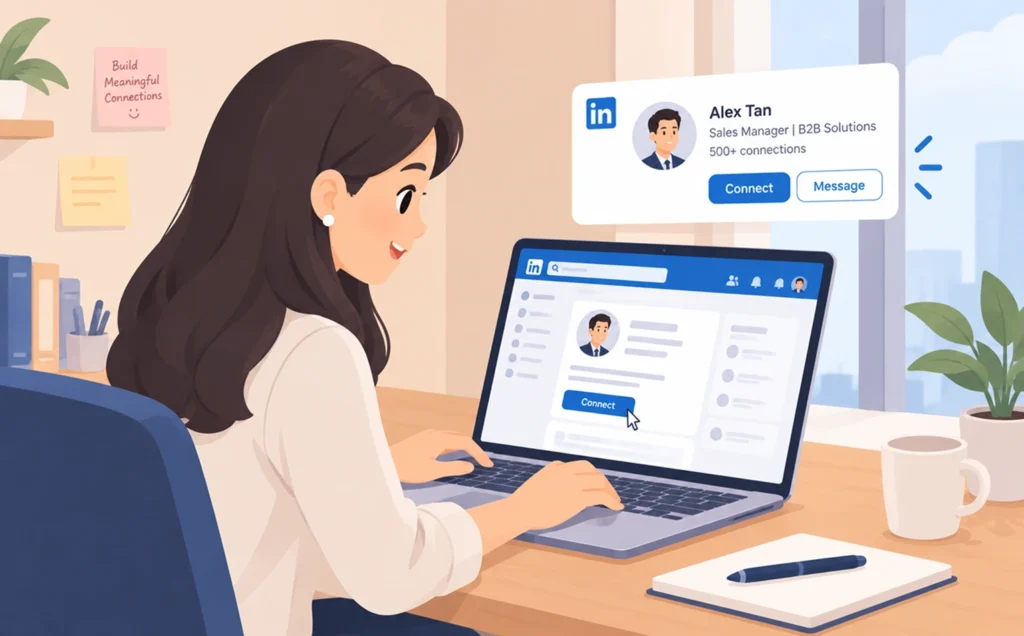
Outbound lead generation is one of the ways of creating your leads. It’s a group of channels for you to reach out to them through outbound strategies.
Of course, every yin has a yang; that’s why many people confuse outbound and inbound lead generation. That’s a topic for another blog, though.
Here, you’ll read about the six channels in outbound B2B lead generation. No bias, no subtle promotional material, just facts.
Key Summary
- Outbound lead generation is the method of directly contacting your leads.
- Effective outbound lead generation can bring in high-value leads.
- B2B companies use software like Leaf CRM to contact their leads through the multichannel messaging features.
What is outbound lead generation?
Outbound lead generation is a method of lead acquisition where you proactively contact them directly. This results in brand awareness.
The method consists of six different channels:
- Cold email
- Cold calling
- LinkedIn outreach
- Paid contact data
- Events and conferences
- Outbound agencies.
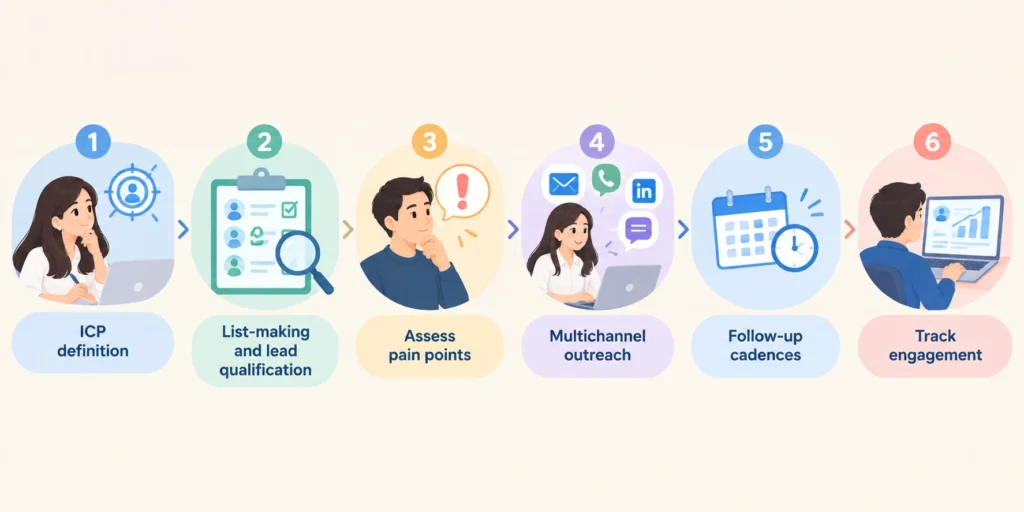
Outbound lead generation focuses on you reaching out to your leads, unannounced. This is also known as cold outreach.
There are six items in the general sequence of the lead generation process to generate outbound leads:
- Ideal customer profile (ICP) definition
- List-making and lead qualification
- Assess pain points
- Multichannel outreach
- Follow-up cadences
- Track engagement
The difference between inbound and outbound lead generation
To make it simple, outbound makes you actively look for your leads. Meanwhile, inbound attracts leads to you.
| Outbound Leads | Inbound Leads | |
|---|---|---|
| Who starts the conversation | Your sales team. Rep-initiated. | The lead contacts you for further inquiry. Buyer-initiated. |
| Cost-per-lead (CPL) | Around $50-$700 per lead. | Around $20-$400 per lead. |
| Speed to first result | Meetings in weeks due to a short sales cycle. Identifying ICP helps too. | Slow build and grows over time due to a longer sales cycle. It's an investment. |
| How it scales | Scales when you tap a new target market. | Scales slowly over time. |
All in all, inbound strategies are cheaper and slower compared to outbound lead generation strategies. Not to mention that they’re acquired faster, and they never get cheaper.
Most companies eventually need both, and which one to start with depends on your product or service. Maybe cold calls and emails are more suitable for you, or maybe it’s an informative post on LinkedIn.
The 6 Modern Outbound Lead Generation Strategies

Generating leads can come in many forms. That’s why choosing many at the same time helps in progressing your leads.
This makes your workflow more efficient when dealing with your decision-makers.
Compared to inbound, outbound is more suitable for bigger deals and closes them faster.
So let’s delve into the six reliable outbound channels as your lead generation tools.
Cold email
Cold emailing is the act of contacting your leads through email. It’s a well-known method for most B2B businesses, but the main thing to look out for is your deliverability.
Email deliverability rate is the chance your email actually lands in someone’s inbox. If it falters, then your prospect won’t even receive your email. It would most likely just land in their spam — and that’s the last thing that you want.
Some elements within it include the inbox placement rate, domain reputation, bounce rate, and spam complaint rate. The general cost for this method (in terms of small to mid-sized businesses) is $50-$400 a month.
Cold calling
Cold calling is an outbound sales method where a sales rep contacts leads who have never interacted with their brand.
This is one of the fastest methods to receive feedback, but most teams won’t do it consistently.
Before you cold-call anyone, you must inform them first. Then, you have to make sure that you properly introduce yourself in your opener.
Cold calling services commonly use the monthly retainer model. This can cost $3,000 to $15,000 a month for U.S. programs, and $1,000 to $2,000 for offshore programs.
LinkedIn outreach
Everything about outreaching in LinkedIn surrounds the social selling index (SSI). 80% of social media B2B leads come from it. This makes it one of the most reliable platforms for outbound marketing
Unlike regular inbound marketing, LinkedIn balances lighthearted professionalism and corporate performance. This makes ethical outreach more important than ever. You have to contact your leads genuinely and provide relevance and transparency.
Besides this, a credible profile is a must. With a proper profile, you can show your legitimacy and reach out. Strategically connecting with your leads makes your interaction with them real.
Paid contact data
Contact data is a record of information meant to identify and reach out to a person or an organization. It usually includes your typical contact information.
If you’re new and you don’t know where to start, you can use a B2B SaAS. A lot of contact data sources provide a subscription model for your B2B outreach.
Salesmotion stated that the costs range from $0.10 per contact on smaller platforms. But $1.50+ on enterprise providers.
This excludes hidden fees that can raise your bill by 30%-50%. You should note that the data quality varies. So you should try a small test list first before signing up for an annual contract.
Events and conferences
Attending business events and conferences is the most direct method you can use to reach out to your leads. Plus, it gives you an actual reason to connect with them.
B2B event marketing isn’t just a simple get-together; it’s a proper brand activity meant for marketers. Cvent found that 88% of marketers actually identify events as a revenue driver.
This makes these events something more than marketing. Because it’s also the perfect ground for networking.
After all, that’s why case studies state that 78% of organizers believe their events are so impactful.
Outbound agency
An outbound agency is a third-party organization that helps you reach out to your leads. These agencies specifically tackle your outbound lead generation.
With a B2B outbound agency, your sales pipeline can run its course smoothly for every lead captured. But here’s the catch. The formula for payment is “rep’s base salary x target hit percentage x 0.7”. So, the total before any commission lands on $5,000-$12,000 a month — disregarding extra fees.
To sum it up:
| Channel | What it takes | Realistic timeline to first results | Who should skip it |
|---|---|---|---|
| Cold email | A verified list, warmed domains, and someone writing and testing copy every week. | 2 - 3 months before you know if it works | Anyone unwilling to maintain deliverability. A burned domain is expensive. |
| Cold calling | A dialer, a list with phone numbers, and someone who will make the calls daily. | Fastest feedback - days, not months | Teams with no one who will actually pick up the phone every day. |
| LinkedIn outreach | A credible profile, research time, and patience with connection limits. | 1 - 2 months | Businesses whose buyers are not on LinkedIn - most trades and local services. |
| Paid contact data | A subscription to a data provider, plus a channel to use it in. | Immediate access, but results depend on the channel | Anyone who has not first proved a message works on a small list. |
| Events and conferences | Budget, travel, and follow-up discipline afterwards. | 3 - 6 months including the follow-up cycle | Teams who do not have a system for working the badge scans afterwards. |
| Outbound agency | A monthly retainer and enough margin to absorb it. | 3 - 6 months, often with a ramp period | Companies who have not yet proved anyone wants the product. |
"Should I do outbound lead generation?"
This depends on three situations that you need to assess before starting. Here’s a chart you can refer to before you start to use outbound!
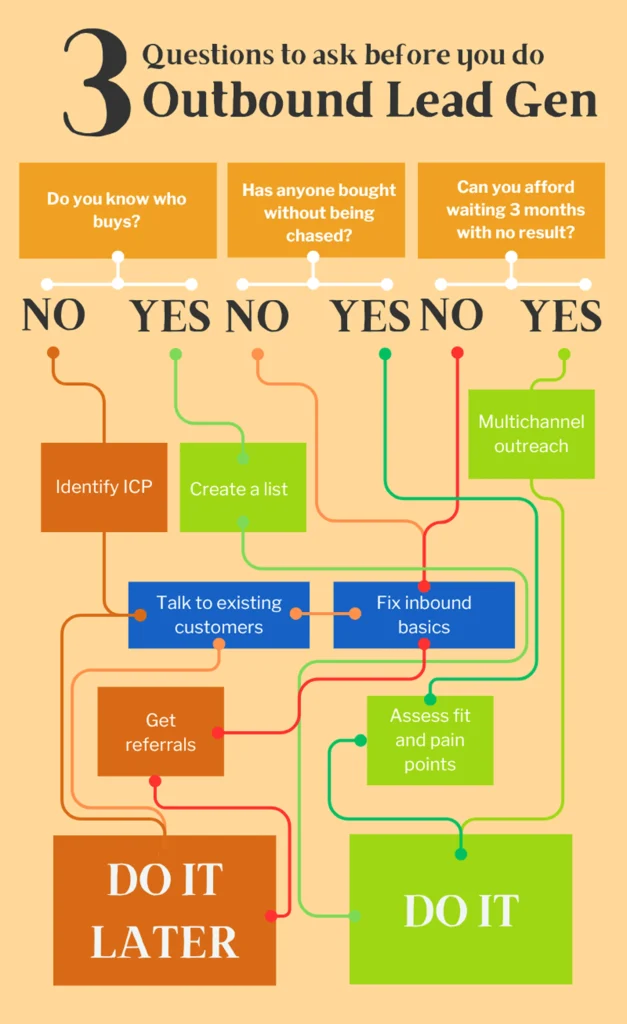
Outbound has gotten harder over the years. People’s inboxes are more crowded than ever; reply rates have fallen.
Outbound works for companies that regularly handle high contract value with a small, identifiable buyer list. It’s not as suitable for brands with low-price products, a broad consumer audience, or one that can’t survive a slow quarter.
Multichannel messagin tools for outbound
Many B2B organizations instantly connect with their prospects through instant multichannel messaging tools. Unlike inbound lead gen, outbound has you contacting your leads. Which is why getting a reply is gold.
Out of hundreds of inbound leads, an outbound lead that replied to your cold message is the most expensive one you’ll ever get.
That’s why you can’t let these replies land and sit for a day until the intent is gone. You want to make sure that there’s an owner per reply, alongside a same-day response.
Leaf CRM provides this feature within the software. You can set up a message template for everyone to use.
The same message to reach out to your leads, and you can do so through many channels. But you should know that Leaf doesn’t have any outbound features like contact data, sequences, or a dialer.
If you’d like to sign up for a free trial and see the messaging tool yourself, then here’s the link to register. No pressure.
Conclusions
Outbound involves details and specific targets to catch effective leads. It works when you have a clear ICP, and it can get expensive when you don’t. So here’s what you’re going to do:
Pick a channel between the six that we’ve covered to test the waters and try running it properly for a quarter. Then, judge the results by counting the replies and results rather than the sends.
But if your business is already catching tons of inbound leads, then don’t eat more than you can chew. If this is the case, then you should fix the follow-up first. Having a hard time managing your leads? Check out Leaf; we provide pipeline management, real-time updates, and mobile integration.
Frequently Asked Questions (FAQ)
1. What is the difference between inbound and outbound lead generation?
Inbound lead generation attracts potential customers through SEO, content marketing, and social media. Outbound lead generation involves contacting prospects directly through cold emails, phone calls, and LinkedIn outreach. The main difference is who initiates the conversation.
2. What does outbound mean in marketing?
Outbound marketing is a strategy where businesses actively promote their products or services to potential customers.
3. What are examples of outbound lead generation?
Examples of outbound lead generation include cold emailing, cold calling, LinkedIn outreach, purchasing contact data, attending business conferences, and hiring outbound agencies. Businesses can combine these methods to reach their target audience and generate qualified leads.
4. Is outbound lead generation effective for B2B businesses?
Yes. Outbound lead generation can be effective for B2B businesses selling high-value products or services. It allows sales teams to identify and contact decision-makers directly. However, its effectiveness depends on having a clear ideal customer profile (ICP), relevant messaging, and consistent follow-ups.
5. How long does outbound lead generation take to work?
Outbound lead generation can take anywhere from a few days to several months, depending on the channel. Cold calling provides immediate feedback, while cold emails and LinkedIn outreach may take one to three months to show measurable results. Events and outbound agencies can take three to six months.
Glossary
- B2B: Business-To-Business
- Lead generation: The method of creating and generating leads for your product or service.
- Inbound lead generation: Leads that are captured through inbound methods such as ads, social media posts, or posters. These leads seek you.
- Outbound lead generation: This is a method of lead generation where you capture qualified leads by reaching out to them directly. You seek for the leads.
- ICP: Ideal customer profile.

Nabilah Haidir is a Content Writer Intern at Red Ant Technology. She had written a book entitled 'A Cup of Poe-e-tea', alongside designing a website as additional substance for it. She had also published an extended abstract about it under UiTM'S Journal of the Language and Society Faculty.