


Sales pipeline management is how you track every open deal through set stages. You keep each deal’s stage, value, and close date up to date. Then you can forecast revenue you trust.
It comes down to a weekly routine. Every deal needs a buyer action behind its stage. It also needs an owner and a dated next step. You mark deals with no buyer contact as lost.
In this guide, I will walk you through what sales pipeline management is, why it is important, the seven best practices, common challenges, and what metrics to monitor.
Key Summary
- Sales pipeline management is the process of tracking and managing active sales opportunities through defined stages to improve deal progression, identify bottlenecks, and maintain an accurate view of potential revenue.
- Effective pipeline management requires a consistent routine. Every deal should have an assigned salesperson, a clear next action, and a specific follow-up date. Review the pipeline weekly and remove inactive deals regularly.
- Seven best practices help maintain a healthy sales pipeline: define clear stages, qualify leads, assign next steps, update deal records, conduct weekly reviews, maintain a steady flow of qualified leads, and remove dead deals.
- Five key metrics to monitor are new deals entering the pipeline, time spent in each stage, stage-to-stage conversion rate, win rate, and average deal value.
- A CRM simplifies sales pipeline management by centralizing deal information, tracking sales activities, assigning ownership, and providing visibility into pipeline performance.
What is sales pipeline management?

Sales pipeline management helps sales teams to track active sales opportunities. It follows each deal through set sales stages. A sales manager can check deal progress and plan the next action.
It tracks two numbers. Pipeline value is the total of all open deals. Pipeline health is how much of that value is likely to close. As Salesloft explains, the former shows volume, while the latter shows whether your deals can hit your sales goals.
Why is sales pipeline management important?
Sales pipeline management matters because it turns abstract numbers regarding your sales performance into ones you can act on. Everyone involved in the sales process gains something:
- Provides visibility into active sales opportunities.
- Helps salespeople prioritize their activities.
- Identifies stalled deals and sales bottlenecks.
- Supports more accurate revenue forecasting.
How to manage a sales pipeline effectively: The best practices in managing the process

To effectively manage your sales pipeline, follow the seven best practices below in order. The first two decide what gets into your pipeline, and the other five keep it functioning steadily.
Define pipeline stages by what buyers do
Each sales pipeline stage should end with a buyer’s action that you can check, such as “booked a demo.” If you mark the stage with rep-focused terms like “proposal sent,” your pipeline can’t tell what your buyer will do next.
Write one exit rule per stage of the sales process:
- Contact made: the lead replied (voicemail doesn’t count).
- Qualified: need, budget, timeline, and signer confirmed.
- Discovery: the buyer agreed on the problem and its value.
- Proposal: the buyer reviewed your offer and booked a follow-up.
Most B2B sales teams need four to seven stages. If two reps would stage one deal differently, tighten the rules.
Qualify leads before they become pipeline deals
A lead counts as a deal only after you confirm through your lead qualification frameworks. BANT is a widely accepted one, especially for small and mid-sized teams. It guides you to confirm four things to qualify a deal: a budget, a real need, a decision maker you can reach, and a timeline. Complex deals with a buying committee may need a deeper framework such as MEDDICC or MEDDPICC.
Qualifying well also speeds deals up. Ebsta’s H1 2024 B2B sales benchmarks found that effective qualifying increased sales velocity 4.7 times.
Give every deal a dated next step
Every open deal needs one owner and one next action with a specific date, for example, “Send the revised quote on next Tuesday.” Without a clear owner, your reps may assume other reps have it, and then your leads will get cold due to no contact.
According to Ebsta, deals that went more than seven days without a future activity booked had win rates 65% lower. Thus, it would be better if ownership starts when a lead arrives, so assign every new lead to one named salesperson straight away.
Update the pipeline after every buyer interaction
Log sales activities and move the stage on the same day in one shared system.
A spreadsheet copes with a few reps. Once two reps overwrite the same row, or nobody knows when a deal moved to proposal, sales pipeline management software saves more time than it costs.
Run a 20-minute pipeline review every week
Ask five questions below during your weekly meeting:
| Ask | Do this |
|---|---|
| What came in? | Check new deals by source |
| What hasn’t moved? | Add a dated next step or move it back |
| What’s dead? | Close it as lost |
| What moved forward? | Confirm a buyer action moved it |
| What’s closing this month? | Ask what must happen to close |
A deal is stuck when it runs well past your historical average for that stage.
Twenty minutes is the floor. In a study of 62 B2B companies, firms spending at least three hours a month on each rep’s pipeline saw 11% greater revenue growth.
Keep enough new deals entering the pipeline
Keep prospecting new leads while you close. If new deals stop, most of the pipeline empties within one sales cycle.
Enough means every rep adds new qualified deals each week, at least as many as those left in the pipeline. Count only deals that match your ideal customer profile (ICP), as Ebsta found they’re won 3.1 times as often.
Clean out "dead" deals once a month
Every month, sort your open deals by last contact date and close any deal past your cut-off as lost. Start with 30 days without contact, then adjust it to the length of your sales cycle.
Send one short check-in first. If there’s no reply, close the deal and record a reason, e.g., budget, timing, competitor, or silence. Over time, those reasons show why you lose deals.
If the buyer comes back, reopen the deal with its history intact. Your pipeline total will shrink, but every deal left will have a responsive buyer and a next step.
Common sales pipeline management challenges
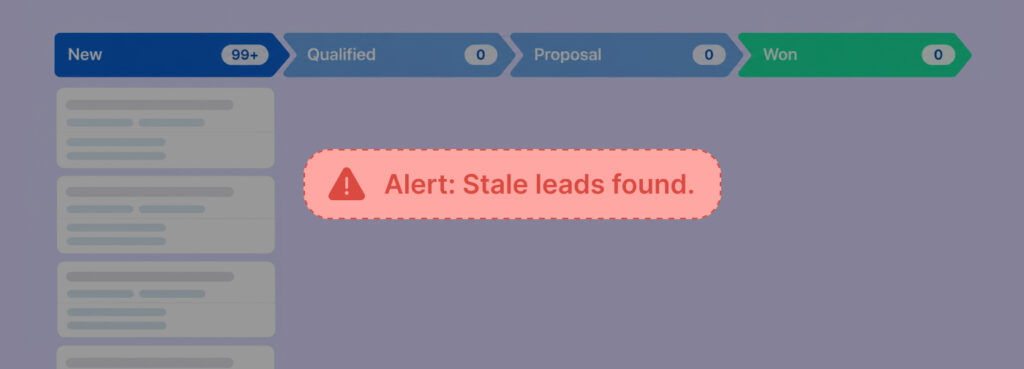
There are five common challenges you may face when managing your sales pipeline:
- Too many old deals in the pipeline
- Too many deals stuck in one stage
- No clear rules for each stage
- Outdated or wrong data in the CRM
- Not enough good leads coming in
Each one makes the forecast less reliable, but each one also has a fix in the practices above.
Too many old deals in the pipeline
A pipeline that looks full misses the quarter because it holds old deals. Their close dates have already passed. However, reps give them a new date so their value stays in the pipeline total.
Thus, during your weekly meeting, ask each owner what must happen to close by that date. Clear out dead deals each month, then your pipeline can show you real and accurate data.
Deals stuck in one stage
Deals that sit in one stage for weeks have often skipped a step. Maybe the rep sent a proposal before confirming the budget. Or the rep never met the person who signs.
Deals that stay too long also win less often. Ebsta found win rates were 203% higher when deals closed within the time past deals spent in each stage. So give each stuck deal a dated next step this week, or move it back a stage.
No clear rules for each stage
If two reps put the same deal in different stages, your stage rules are missing or unclear. Then stage counts mean something different for each rep.
Managers often aren’t trained to apply the rules either. In the Vantage Point study, 61% of executives said their managers weren’t trained enough. Firms that did train them grew revenue 9% faster.
In this case, write a buyer-action exit rule for each stage. Then walk every manager through it.
Outdated or wrong data in the CRM
When the CRM doesn’t match what reps say, records are often updated just before meetings. A rep says a deal closes next week. But the CRM shows no activity for a month.
Some records are also changed to look better. In Validity’s survey, 75% said staff make up data to tell the story leaders want to hear.
Therefore, require same-day updates. In the review, judge each deal by the buyer’s last action, such as a reply or a booked meeting.
Not enough good leads coming in
Busy reps with falling win rates often have too few deals that fit your ICP. Prospecting slips when reps are busy closing. And many leads that do come in are a poor fit.
Lead qualification matters here. Qualify every lead against your ICP before it enters the next sales stage. Meanwhile, to ensure you have enough leads in your pipeline, keep a weekly time slot for prospecting.
Sales pipeline metrics to monitor
Your sales analytics can show you dozens of charts, yet five sales pipeline metrics below tell you most of what matters. Together, they drive the revenue your pipeline earns each day, i.e., your sales pipeline velocity.
| Metrics | What it is | How to get it | What a bad result means |
|---|---|---|---|
| Deals entering per week | New deals that enter your first stage each week, split by source. | Filter your CRM by created date for the last seven days. Group the results by lead source. | A drop, or one source supplying most deals, means next quarter's revenue is at risk. |
| Time in stage | The number of days a deal stays in one stage before it moves on or drops out. | Most CRMs log stage change dates. Average the days between entry and exit for each stage. | Deals pile up in one stage. Its exit rule is unclear, or reps skip the buyer's real next step. |
| Stage-to-stage conversion | The share of deals that move from one stage to the next. | Divide deals that reached the next stage by deals that entered this one over the same 90 days. | A sharp drop at one stage marks a weak step, such as loose qualifying or rushed proposals. |
| Win rate | The share of closed deals that you won. | Divide the deals you won by all closed deals, won and lost, in the same quarter. | A falling rate points to poor qualifying. A very high rate often means reps leave lost deals open. |
| Average deal value | The typical revenue from one won deal. | Divide total revenue from won deals by the number of won deals in the period. | A shrinking value means heavy discounts or smaller buyers. Check negotiation before you blame lead quality. |
If tracking all five is burdening your sales and marketing team, begin with deals entering and time in stage first. The other three need a full quarter of data to mean much.
How CRM software supports pipeline management
A CRM (customer relationship management software) keeps every deal in one place, along with its stage, its owner, and its next step. It also records the date each deal enters and leaves a stage. That record lets you run the weekly review and track time in stage without counting by hand.
Not every team needs a CRM yet. If a few reps share a few dozen deals, a shared spreadsheet can handle the weekly review. Spreadsheets tend to break down in small ways first. But once you see these signs:
- Two reps overwrite the same row.
- Nobody can say when a deal moved to proposal.
- A rep spends Friday afternoon updating cells instead of calling buyers.
The spreadsheet is costing you more time than a CRM would.
When you compare tools, look for four features that support the routine in this guide:
- Stages you can rename and reorder yourself,
- A flag on deals that have sat too long,
- One owner per deal enforced,
- Updates from a phone so the board reflects the day, not the night before.
Leaf CRM covers these needs for your sales teams. You can build pipelines with your own stages, and the free Starter plan includes one pipeline. Each new lead goes to one named salesperson the moment it arrives. Managers can compare how fast each rep responds and track monthly sales targets. Marketing can track return on ad spend in real time. Reps can move deals through the pipeline from the mobile app on iOS, Android, or Huawei.
Leaf doesn’t forecast. It has no weighted pipeline and no win probability by stage. If you need a revenue forecast, you’ll need a separate forecasting tool alongside it.
Conclusion
A pipeline is only useful when every deal has an engaged buyer, an assigned owner, and a dated next step. A weekly meeting helps you track your pipeline health.
Start this week with two steps. Put a dated next step on every open deal. Then run your first 20-minute review.
Want to manage your sales pipeline automatically? Try Leaf CRM free with no credit card.
Frequently asked questions (FAQs)
What are the key benefits of effective sales pipeline management?
The first benefit is faster growth. According to Harvard Business Review, B2B companies that mastered three pipeline practices saw 28% higher revenue growth.
The second is a sales forecast you can trust, because dead deals leave the board each week. The third is focus. A rep with 25 open deals can see which five need a call today, instead of chasing the loudest buyer.
What are the stages of a sales pipeline?
The seven stages above are a default setting, and having 4-7 stages is advisable for a sales team. You need to consider your own situation to decide whether to adopt the whole 7-stage template or adapt to your own version. After all, fewer clear ones beat more vague ones.
How does a sales pipeline differ from a sales funnel?
A pipeline tracks single deals. A funnel tracks groups of buyers.
For example, in a tech company, a pipeline shows that the Acme deal sits in proposal, worth $40,000, with the next call on Friday. Its funnel shows that 1,000 webinar sign-ups became 80 qualified leads, an 8% conversion rate.
Reps use the pipeline to work deals. Managers use the funnel to find where buyers drop off.
How can AI improve sales pipeline management?
AI can log calls and emails to the CRM, score new leads, and flag deals that have gone quiet for two weeks. Salesforce’s 2024 survey found that 83% of teams using AI grew revenue, against 66% without it.
Still, AI works only with the data in your CRM. Dead deals give it bad inputs.
How do you build and optimize a sales pipeline?
Begin with clear qualification criteria so the team knows which leads belong in the pipeline. Next, map stages to real customer decisions. Give each stage clear entry and exit rules. Track deal value, close dates, conversion rates, and stage time. Review these measures often, then requalify or remove deals that stop moving.

An SEO content writer and a researcher focusing on CRM, digital literacy and AI literacy.