

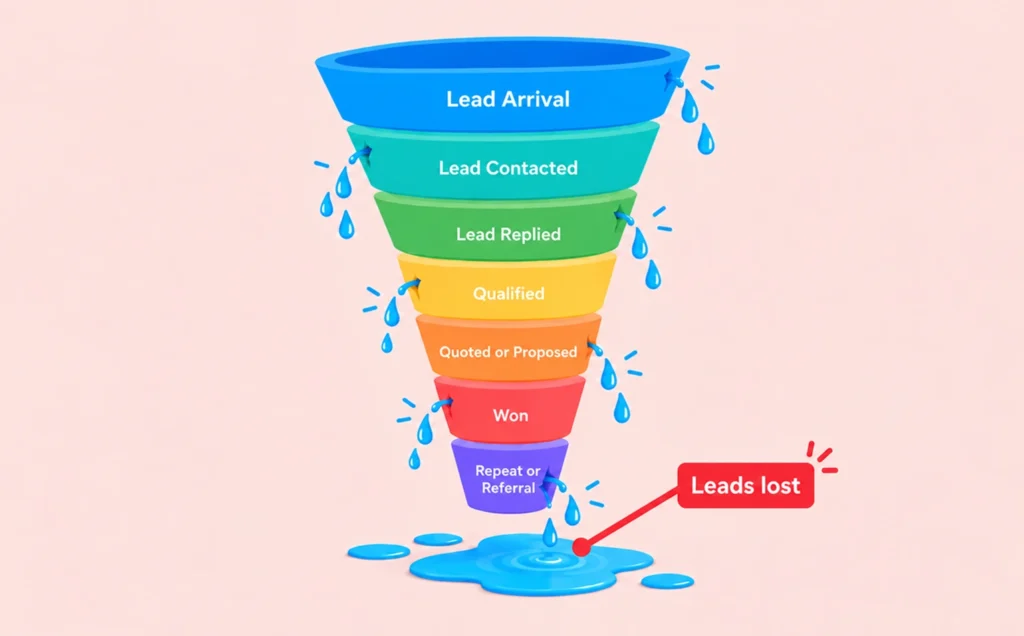
A sales funnel leakage can affect both your sales cycle and any sales strategies you have got in store.
You’ve got your sales funnel stages all figured out; the marketing campaigns are performing well. And you are capturing a ton of leads. But out of all leads, only six were closed.
What happened? How is your funnel performance so lacklustre…? Why is there a leak in the funnel?
In this article, we’ll explore what to measure and manage at each stage of the sales funnel, how to find the leaks, and common causes.
Key Takeaway:
- The sales funnel has seven stages: Lead Generation, Arrival, Contacted, Replied, Qualified, Quote or Proposed, Won, and Repeat or Referral.
-
Steps to find leakage:
- Line up your stage counts.
- Find the biggest percentage drop.
- Prioritize the stage with the highest percentage drop.
What is sales funnel leakage?
Sales funnel leakage occurs when a funnel is improperly managed, and they often go unnoticed until too much damage is done. Not only that, but they can also happen at every stage. Therefore, it is important for you to immediately identify the issue and fix it.
What to measure at each stage of the sales funnel
The pillars of every funnel are the top of the funnel (ToFu), the middle of it (MoFu), and its bottom (BoFu). What constitutes these categories tends to differ for everyone, so it will result in different sales funnel metrics. With that said, the general consensus of a sales funnel consists of six stages, which are:
- Awareness
- Interest
- Consideration
- Intent
- Purchase
- Retention (post-purchase)
Each of these stages have their own processes going through them, which we’ll cover here:
| Stages | What goes on in them | What to measure |
|---|---|---|
| Awareness | Lead generation | Marketing efforts to capture your leads and place them within the funnel |
| Interest | Lead arrives | Leads per week, by source |
| Interest | First contact | Number of leads contacted, and time to first contact |
| Consideration | Lead replied | Number of leads who replied to first contact |
| Consideration | Qualified | Total of leads' replies that become real opportunities |
| Intent | Quoted or proposed | Number of qualified leads who receive a quote, and how fast |
| Purchase | Closed and won | Amount of quotes that close, and time from quote to decision |
| Retention | Repeat or referral | Share of customers who buy again or refer |
As you navigate the sales funnel, you’ll find yourself figuring out the numbers to work with throughout the process.
You can get these numbers from a customer relationship management (CRM) software if you have one, or a spreadsheet with one row per lead if you don’t. Any business-to-business (B2B) sales team needs some sort of system to manage their leads.
The stage conversion rate
Before you get to investigate what is wrong with your funnel, the first thing you need to cover is your stage conversion rate. This shows you how effective each of your stages really is.
Thus, all of your sales funnel stages need to focus on a couple of things. The total count of those who reached a stage and the share of the previous stage compared to the current one. The result is the share that you kept, while the rest are leaks.
For example, your arrival stage brought in 40 leads, and your contacted stage only displays 22 leads. Therefore, the stage conversion rate is 55%. Here you can see that you’ve lost about half of your leads because of the leak.
Regardless of how impressive your funnel strategy is, a leak can severely impact your team’s sales execution.
The key stages and their numbers
Besides the stage conversion rate, you also want to focus on the numbers for these two stages: lead contacted and quoted or proposed. The time of the first contact and the time from quote to decision can guide you and ensure that leaks can be avoided. Here are the formulas you can use:
- Time to first contact = time of first contact – time the lead arrived
- Time to decision = date won or lost – date the quote was sent
Although there are a lot of published benchmarks you can refer to, they’re rather unreliable if you’re new. So, to provide a useful baseline for your sales funnel, you can compare your own funnel’s performance against itself over the past 3 months.
Remember, this funnel helps in streamlining the sales process so your brand is always generating income. Hence, make sure that your sales cycle length is short and simple because of the funnel.
How to identify leaks in your sales funnel
Here are three simple steps to find your leaks:
- Line up your stage counts.
- Find the biggest percentage drop.
- Prioritize the stage with the biggest percentage drop.
For example, you have a month’s worth of leads going through your sales funnel. You can’t help but notice how few of them actually closed. From here, you can line up your current stage counts and find the stage with the biggest percentage drop.
To illustrate:
| Stages | Total count | Stage conversion rate |
|---|---|---|
| Lead generation | 49 | -- |
| Lead arrival | 38 | (38 leads arrived ÷ 49 leads generated) × 100 = 77.5% |
| Lead contacted | 20 | (20 leads contacted ÷ 38 leads arrived) × 100 = 53% |
| Lead replied | 18 | (18 leads replied ÷ 20 leads contacted) × 100 = 90% |
| Qualified | 12 | (12 leads qualified ÷ 18 leads replied) × 100 = 67% |
| Quoted or proposed | 10 | (10 leads quoted or proposed ÷ 12 leads qualified) × 100 = 83% |
| Won | 6 | (6 leads won ÷ 10 leads quoted or proposed) × 100 = 60% |
| Repeat or referral | 5 | (5 leads repeat ÷ 6 leads won) × 100 = 83% |
In this case, the stage you want to focus on is your second stage.
Common causes for leaks
Now that you know how to look for the leaks, what’s the diagnosis?
Every funnel stage has different reasons that could’ve caused this, so it’s best that you immediately address and fix them.
| Stage | What to measure | What a leak looks like | Most common cause |
|---|---|---|---|
| Lead generation | The amount of leads you catch in a day. | Too little leads caught, or junk leads | The lead source used isn't suitable for the target audience |
| Lead arrives | Leads per week, by source | Fewer than expected, or lumpy | A campaign stopped, or a form broke. Check the source before the funnel. |
| First contact | Share contacted, and time to first contact | Contacted late, or not at all | Nobody owned it. The lead waited in an inbox while a competitor called. |
| Lead replied | Share who replied to first contact | Contact made, silence after | Generic first message. It did not mention what they actually asked about. |
| Qualified | Share of replies that become real opportunities | Lots of conversations, few real deals | No definition of qualified. Everyone who replied got counted. |
| Quoted or proposed | Share of qualified leads who receive a quote, and how fast | Qualified leads waiting days for a price | Quoting is manual and slow. The lead cooled while waiting. |
| Closed or won | Share of quotes that close, and time from quote to decision | Quotes sent, no decision either way | Nobody asked for the decision. The deal drifted. |
| Repeat or referral | Share of customers who buy again or refer | Customers vanish after the first purchase | Follow-up stopped at the sale. |
Most common sales funnel leaks
Between all of these leaks, there are three that matter most for you to optimize your sales funnel.
Dead on arrival: The first leak
The first leak begins at the first stage, where leads arrive but nobody contacts them fast enough. Unfortunately, this is the most common leak in small businesses. It’s also a speed and ownership problem where link routing and instant lead assignment are the highlights to fix these issues.
"I think this guy's probably qualified...": The second leak
The qualified stage leaks because there’s no definition of what “qualified” is. Thus, making the MoFu only full of conversations that were never really deals. Every team member of your sales and marketing team has a rough idea of what qualified means, but not a shared definition, making it confusing for everyone to handle the leads.
Accidental ghosting when you're supposed to be closing: The third leak
Finally, the won stage leaks when quotes are requested and sent, but nobody comes to a decision. The deal ends up on hold, gathering dust in your spreadsheet. The longer you take to tend to your lead here, the lower the chance for you to win even if you use the sales funnel efficiently.
Fixing the common leaks
A successful sales funnel must be well-rounded, with no leaks affecting it. That’s why fixing the common leaks is fundamental to your funnel management system.
| Leaks | Fix |
|---|---|
| Uncontacted leads | Give every lead an owner (salesperson) the moment it arrives, with a deadline for the first contact. The five-minute rule is everything. You'll know that it worked if the next stage has more leads compared to before. |
| No reply | Make sure that your first message addresses what they asked about and offers one clear next step. This fix worked if you receive a reply from the leads. |
| Replied but not qualified | A shared definition helps with the alignment between sales and marketing teams. Write the qualifications in one sentence before moving on. If a lead doesn't meet the requirements, politely explain to them. This fix works once you're receiving more qualified and quality leads. |
| Qualified but slow to quote | Set a deadline for the quotes and track it using your management system. Make sure that everyone is well-informed of the current status for each quote. This fix worked if you've received more quote requests than before. |
| Quoted but no decision | Ask your leads about their decision and give them a date. Follow up with them and take action. You would know this worked if you've managed to receive a clear yes or no. |
| Won but no repeat | Send a follow-up after the delivery, alongside a request for a referral. This worked if you've managed to gain loyal customers later. |
The one rule you need to always remember is to fix one leak at a time. Then, measure the results throughout the sales funnel before touching the next leak. This is due to the fact that your entire sales funnel is meant to streamline your team’s work, not complicate it.
How to prevent future sales funnel leaks
A review every month will always improve your funnel’s performance. Moreover, it only takes 30 minutes every time, and you ask the same five questions.
- How many leads came in and from where?
- Where was the biggest drop?
- Is the biggest drop at the same stage as last month?
- What did you change?
- Did the change work?
However, you should always review your contacted leads every week. The leak that stems from this stage can go wrong, real fast. It’s the one number you want to consistently keep track of for an effective funnel.
If your fixes still aren’t working, be patient. You don’t have to rebuild the funnel every month just because the things you fixed aren’t immediately working. You just have to change one thing, measure the severity, then take the necessary next steps for your sales process.
You can stop measuring your stages once everything’s working fine for three months. When you have a well-defined sales funnel management, you can focus on something else instead, like your sales pipeline.
How a CRM helps with sales funnel leakage
A CRM system helps you see your leads’ status in real time. Although your sales team can use a spreadsheet to keep track of your leads, someone has to always update it. One mistake can cause the first leak because a spreadsheet can’t provide you with your leads’ live status.
With a CRM, every salesperson is instantly assigned a lead. Its automatic lead management makes it easy for you to move through the sales process every time.
Additionally, stalled deals are flagged instead of hunted — which you would have to do manually with a spreadsheet. Each lead is also timestamped the moment they arrive and on first contact.
How does Leaf CRM help with sales funnel leaks?
Leaf CRM captures your leads from ads and forms, then it immediately assigns them to a named rep in seconds. The system also has phone alerts, stuck-deal flags, rep response-time comparison, live return-on-ad-spend (ROAS) categorized by campaign, and custom reports.
Leaf is a straightforward, customizable CRM system. However, it doesn’t do funnel charts or marketing automation for the ToFu. But, if you’d like to see what automatic lead capture and assignment looks like, you can try out our free plan.
Conclusion
To sum it all up, managing your sales funnel isn’t only about ensuring that your leads progress through the funnel or deciding the best funnel management strategy. It’s also about maintaining it and finding the biggest leak, which can happen earlier than you think.
Funnel management requires maintenance, as do all other metaphors for different types of strategies. B2B sales funnel specifically is meant to help you navigate different factors, like multiple stakeholders.
So, try out this guide by counting how many leads reached each stage last month. Then, use our formulas to find the biggest stage with a percentage drop and focus on fixing that stage first and foremost.
If you only receive a handful of leads a month, then you can just rely on the good old spreadsheet instead of investing in a CRM software. Just check each lead by referring to your list.
If you’d like to try, Leaf CRM has a free plan for up to three salesperson(s), alongside three lead sources you can integrate with it.
Create your free account today — no credit card needed.
Frequently asked questions (FAQ)
What is the purpose of a sales funnel?
A sales funnel is designed to provide a streamlined experience for your leads to buy from you. Accordingly, the funnel begins once your potential sales leads arrive from your lead generation, to nurture them and to close the deals.
What is a leakage in business?
A leakage in business can refer to a sales funnel leakage. Each of your sales funnel stages (lead generation, lead arrival, first contact, lead replied, qualification, quoted or proposed, closed and won, repeat or referral) can leak because of different factors, causing you to lose your leads.
What are the five stages of the sales funnel?
The five stages of a sales funnel are awareness, interest, consideration, intent, and purchase. These stages align with the top of the funnel (ToFu), middle of the funnel (MoFu), and bottom of the funnel (BoFu).
Can you give me an example of a sales funnel?
An example of a sales funnel can have six different stages for leads: awareness, interest, consideration, intent, purchase, and retention. Within these stages, there are eight processes happening in them: lead generation, lead arrival, first contact, lead replied, qualification, quoted or proposed, won or lost, and repeat or referral. Your leads will go through the sales funnel as they progress, making it easier for you to track them through the visualization.
What is the difference between a sales funnel and a sales pipeline?

Nabilah Haidir is a Content Writer Intern at Red Ant Technology. She had written a book entitled 'A Cup of Poe-e-tea', alongside designing a website as additional substance for it. She had also published an extended abstract about it under UiTM'S Journal of the Language and Society Faculty.