

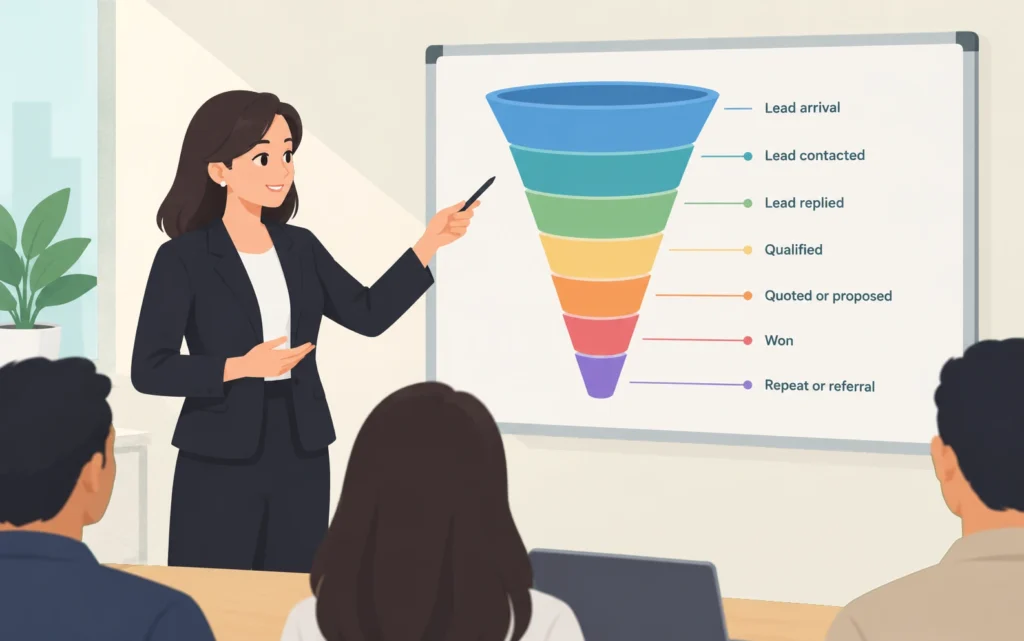
Your sales funnel is a direct path that your leads take from start to end. It’s one of the well-known sales strategies. This is why every business needs proper sales funnel management.
A funnel’s performance entirely relies on its management: how you update the information within it, maintain it, and clean it.
In this article, we’ll explore what to measure and manage at each stage of the sales funnel, why it’s important, the challenges, and the metrics you should take note of.
Key Takeaway:
-
The sales funnel has six stages, which are:
- Awareness: Lead generation
- Interest: Lead arrival, first contact
- Consideration: Lead replied, qualification
- Intent: Quoted or proposed
- Purchase: Closed and won
- Retention: Repeat or referral
- The sales funnel management process consists of using a customer relationship management (CRM) system to track it, identifying leaks, and monitoring the funnel to improve it.
- You can use a CRM to manage your sales funnel with features like the sales pipeline, multichannel lead sources, and lead tracking.
-
Common challenges of managing a sales funnel include:
- Fixing the leaks
- Not catching enough leads
- Qualifying your leads
- Balancing outreach with personalization
What is sales funnel management?
Sales funnel management is the process of optimizing your sales funnel in order to provide the best customer experience for your leads.
A sales funnel is the journey your leads take from start to end. Each stage of the funnel guides your leads toward closing the deal. The basis of how it works is categorized by the visualization of the funnel itself. Thus, we have the top of the funnel (ToFu), middle of the funnel (MoFu), and the bottom of the funnel (BoFu). These pillars tend to differ for everyone, as they directly impact your sales funnel stages.
Besides this, the stages of the funnel are also designed around these six stages:
1. Awareness
2. Interest
3. Consideration
4. Intent
5. Evaluation
6. Purchase
These stages sound simple enough, but what really goes on in each of them? Well, in each of the stages, processes like lead generation, lead arrival, and more are taking their course to channel your leads to the bottom of your funnel.
What a sales funnel isn’t is a sales pipeline. A sales pipeline is the view of the sales reps themselves. It’s like a progress chart that provides your marketing and sales teams with a view of all of your leads’ progress.
Why is sales funnel management important?
Managing your sales funnel is important because it optimizes the path for your leads to follow through. Maintaining it ensures that their experience is covered from head to toe, giving you a chance to close at least one deal.
By guiding your prospects through the sales funnel, you can see how effective each stage in your funnel is through the conversion rate. Your sales funnel is useful for any of your campaigns, regardless if it’s inbound or outbound. This makes it easier for you to identify how effective a campaign is.
What are the stages of a sales funnel?
Many brands differ in their stages because of what they count as the first stage. Some believe that the first one is lead generation; some don’t. This article is the former. So, there are seven stages of the sales funnel, which are:
- Awareness: Lead generation
- Interest: Lead arrival, first contact
- Consideration: Lead replied, qualification
- Intent: Quoted or proposed
- Purchase: Closed and won
- Retention: Repeat or referral
Awareness
Lead generation
The marketing efforts to generate your leads belong in the marketing funnel because labeling lead arrival as the top of your funnel wouldn’t be accurate. This stage focuses on your lead generation campaigns. This can be either inbound or outbound lead generation.
Keep track of which lead sources work the best by comparing their cost per sale (CPS) with their cost per lead (CPL). Then, optimize the lead sources with attractive ads and rich lead forms.
Interest
Lead arrival
This stage constitutes the arrival of a lead from your lead generation efforts. The moment your lead arrives, ensure that it’s instantly assigned to a named salesperson. The quicker your speed to lead is, the more likely you’ll be able to guide your leads to the next stage.
For your sales funnel, count the total leads you’ve captured in a week and their sources. By doing so, you can see the average number of leads you capture weekly, alongside which lead sources are the most effective.
First contact
The famous 5-minute rule is the general rule of thumb when it comes to first contact. Speed to lead is the star of this stage, because every second counts. A 2007 MIT study found that you’re 21x more likely to qualify a lead if you call them within 5 minutes compared to waiting for 30 minutes.
Once your leads are contacted, ensure that further action can be taken. Sometimes, there have been instances in which leads were caught, but not contacted. This results in warm leads getting cold.
Consideration
Lead replied
A reply from your lead must instantly be tended to. This stage decides whether they need further nurturing down the line, or if they can proceed to the next stage. You can evaluate them by categorizing them under cold, warm, or hot leads. Though, those who replied are most often warm or hot leads.
Depending on the means of communication, you need to cater to the ones your leads prefer. For example, if they called you, then you need to pick up. If they messaged you, then a reply must be instant. This is why lead management makes an effective funnel.
Qualification
Lead qualification is a stage many people confuse with lead scoring. Qualifying your leads means checking if they can purchase your products or not, regardless of how enthusiastic they can seem. This stage is important because without it, then you may waste essential resources that can be spent on winning the right leads instead.
Lead qualification can be done both online and offline. When you move a qualified lead through the sales process, it is more likely for you to close. This is especially so if you also stick to an effective follow-up cadence.
Intent
Quoted or proposed
This is one of the biggest signs of you getting closer to winning the deal. As you move through the sales process, meetings and discussions will be held in order to satisfy both parties in regard to what you need. The moment the quotes and proposals are sent is the moment when your leads arrive at this stage.
Take note of how many quotes or proposals were sent to your qualified leads, and how fast it happens. Sales funnel management involves consistent updates between you and your team; therefore, everyone should be aware of each other’s progress.
Purchase
Closed or won
This stage counts once you’ve properly closed the deal. What counts as a won deal or a closed one should be recorded within your CRM system to make sure that every cent is counted. By doing this, you’ll be able to find your cost per lead and win rate.
If you lose the deal, then part ways with the other party formally. Send them an email stating your departure, and if they would like to continue the conversation, then they’re always welcome to.
Retention
Repeat or referral
Assuming that you’ve won a deal, a repeat customer or a referral is one of the best things that can happen to you and your brand. Your entire sales funnel is meant to guide your prospects’ journey to purchase your service or products. An effective sales funnel provides repeat customers or referrals.
Throughout the sales funnel stages, your lead has gone through the process if convincing them to buy from you. This stage should encourage them to share word of mouth about your product, thus marketing your brand.
| Stages | What goes on in them | What to measure |
|---|---|---|
| Awareness | Lead generation | Marketing efforts to capture your leads and place them within the funnel |
| Interest | Lead arrives | Leads per week, by source |
| Interest | First contact | Number of leads contacted, and time to first contact |
| Consideration | Lead replied | Number of leads who replied to first contact |
| Consideration | Qualified | Total number of leads' replies that become real opportunities |
| Intent | Quoted or proposed | Number of qualified leads who receive a quote, and how fast |
| Purchase | Closed and won | Number of quotes that close, and time from quote to decision |
| Retention | Repeat or referral | Share of customers who buy again or refer |
How do you manage a sales funnel effectively?
When building an effective sales funnel, most people often forget to manage them properly and to maintain them. This results in leaks, costing you your precious leads that you generated. Managing a sales funnel should be a simple process of consistent upkeep, which consists of updating, sustaining, and cleaning your funnel.
Use a CRM to track sales funnel activity
Keep your sales pipeline updated
When you navigate your sales funnel, everyone on your team should consistently update it using your management system’s sales pipeline. Besides that, you need to clearly define each stage and its metrics to decide when a lead is considered to be moved onto the next stage.
Your sales pipeline should create alignment between sales and marketing teams. As you train them, create a habit of relying on your management system and utilize it to its fullest by consistently updating it.
Identify and fix sales funnel leaks
A business can identify where their leads drop off by referring to their sales cycle. A sales cycle is designed to continuously bring in sales for you, if a stage is falling behind, leads drop. So, you can identify which stage it is by comparing their conversion rates and pick out the one with the lowest. As you improve your sales cycle stage, you would know which sales funnel stages needs to be improved too.
Even a well-defined sales funnel can have leaks, and there could be different reasons that cause them.
Besides that, your funnel should also stay relevant. You can do this by checking its definition and decision rules every month. A review each month provides an up-to-date funnel that optimizes your customer experience. When you frequently maintain your funnel, it can be utilized for any of your marketing campaigns.
Monitor and improve funnel performance
In order to check if your sales funnel is working or not, you can evaluate it by referring to certain metrics. As you know, we use the sales funnel to convert leads and get sales. Therefore, some metrics you can use to check your sales funnel’s quality are the lead-to-customer conversion rate, stage conversion rates, the customer acquisition cost, and your CPS.
- Lead conversion rate = (Number of leads converted to customers/Total number of leads generated) × 100
- Stage conversion rate = (Total count of the stage/Total of people who reached the stage before) × 100
- Customer acquisition cost = Total sales and marketing costs of a campaign/Total new customers acquired
- Cost per sale = Total sales and marketing costs of a campaign/Number of sales
Your sales funnel is designed to streamline the sales process your leads and prospects go through. Therefore, every funnel stage should provide a specific function that guides them, and you can evaluate its effectiveness with the metrics above.
What are the common challenges in sales funnel management?
Some common challenges in managing your sales funnel are fixing the leaks from the stages, not acquiring enough generated leads, distinguishing whether a lead is qualified or not, and balancing your outreach with personalization.
As you navigate the sales funnel, these common challenges could easily be overlooked when things get hectic. The problem when this happens is the fact that your customer will have a muddled and messy sales experience. Your sales team could contact a lead twice, thinking that they haven’t been contacted yet.
So, how do you get over these challenges as you work through your sales activities?
- Fixing the leaks: Identify the stage with unusually high drop-off rates and focus your efforts there for the next week.
- Not catching enough leads: Optimize your lead generation efforts and integrate your effective lead sources to your campaign using a CRM.
- Qualifying your leads: Describe distinct criteria that qualify your leads and standardize it with your team.
- Balancing outreach with personalization: Segment your leads based on their interests, needs, buying stages, and other criteria. Once you’ve done this, you’ll be able to customize your follow-up messages to cater to them.
Which metrics should you track?
There are three metrics that you should track frequently: the stage conversion rate, your lead conversion rate, and your customer lifetime value. The metrics you track for your sales funnel showcase the necessary data you need to see whether your funnel works or not.
- Number of leads: Keep track of how many leads are at certain stages.
Stage conversion rate: The stage conversion rate shows you how effective your stages really are. - Stage conversion rate = (Total count of the stage ÷ Total of people who reached the stage before) × 100
- Lead-to-customer conversion rate: (Number of leads converted to customers/Total number of leads generated) × 100
- Customer lifetime value (CLV): CLV provides a glimpse of your customer retention rate.
- CLV = customer value x your brand’s average customer lifespan
Customer value = average purchase cost x average frequency rate of customer’s purchases
Average customer lifespan = average number of years that a customer stays active/total number of customers - However, the CLV metric is optional if you want to keep track of your customers’ retention. It’s not something you should completely rely on to measure your funnel’s conversion.
- CLV = customer value x your brand’s average customer lifespan
How can CRM software improve sales funnel management?
Clearly, a sales funnel consists of many things to take into account to manage it. CRM software handles this by providing different features that mitigate the challenges and make it easier for you to run your sales funnel.
- Sales pipeline: The sales funnel enables businesses to streamline their leads’ experience to purchase their products, but the sales pipeline is designed for your salesperson(s). Give your sales team a platform that helps them with managing the leads assigned to them using a visualized sales pipeline that’s easily customized and managed.
- Multichannel lead sources: Integrate your preferred lead sources for your marketing campaigns and immediately have your leads assigned to a named salesperson. Multichannel lead sources provide different virtual means for you to catch your leads.
- Automated reports: CRM provides different types of reports for you to refer to based on the data you’ve provided, such as monthly sales by the team, your campaign overview, sales team performance report, and your sales pipeline performance.
Conclusion
Managing your sales funnel can be a hassle, but a successful sales funnel provides a valuable experience to your leads.
Funnel management requires maintenance, as do all other metaphors for different types of strategies. B2B sales funnel specifically is meant to help you navigate different factors, like multiple stakeholders.
Want to learn more? Check out our blogs about what a CRM system is and the basics of digital marketing. Besides that, we also have a free starter pack for up to 3 salesperson(s), with 3 lead sources to help you out.
Create your free account today — no credit card needed.
Frequently asked questions (FAQ)
What is a sales funnel?
A sales funnel is your leads’ experience throughout your sales process, from their capture through lead generation to the advocacy your customers may provide in the future. There are seven main stages of a sales funnel: awareness, interest, consideration, intent, evaluation, purchase, and retention.
Do sales funnel work?
Yes, because the sales funnel engages your leads to your brand, making it easier for you to convert them into paying customers. An effective sales funnel management strategy is to calculate your stage conversion rate to improve them.
What is funnel management in sales?
What is the difference between a sales funnel and a sales pipeline?
Is a sales funnel still relevant today?
Definitely, but the shape has evolved, and it’s more malleable than ever now. There are multiple forms of a sales funnel management plan, but the leak-finding method hasn’t changed. Leakage can still happen even when you have effective sales funnel management. This makes the maintenance of the funnel important.

Nabilah Haidir is a Content Writer Intern at Red Ant Technology. She had written a book entitled 'A Cup of Poe-e-tea', alongside designing a website as additional substance for it. She had also published an extended abstract about it under UiTM'S Journal of the Language and Society Faculty.