

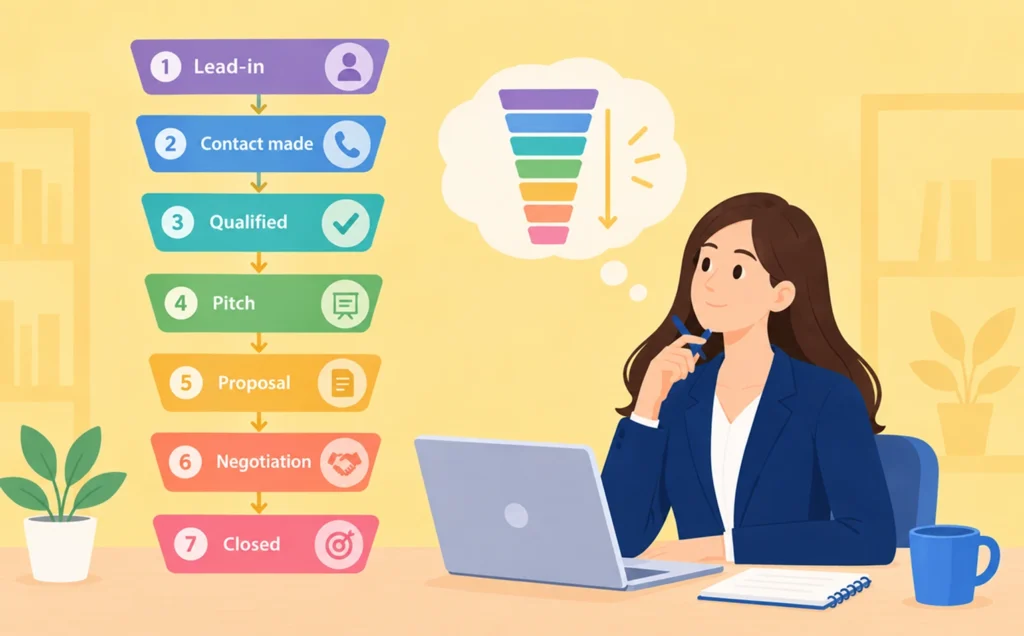
Now, a question most people leave out when it comes to sales pipeline management is: When should you move a deal to the next stage? You have an idea of what your sales pipeline stages look like, but what are the signs you need to look out for?
Picture this: two sales reps are looking at the same deal and disagree about which stage it’s in. One is saying that they’re at the proposal stage; the other says they’re at negotiation. This makes the forecast a fiction — barely an accurate prediction, just a glorified guess.
The exit criteria of every stage is what most guides leave out, and that’s exactly what you’ll be reading about in this one.
Key Summary
- The 7 sales pipeline stages are lead-in, contact, qualifying, pitching, proposing, negotiating, and closing.
- The first thing you want to do is write down what "qualified" means for your team.
- In stage 1 of the pipeline, maintain pipeline regularly, and formally close lost deals.
The 7 Sales Pipeline Stages Explained
The sales pipeline stages help you visualize the current progress of a deal. It gives both you and your sales team a good view of how everything’s looking and what to do next.
Specifically, for your salesperson(s), a sales pipeline helps them identify the deals that need attention and what they need to do next — which is usually to follow up with them. For sales managers or sales leaders, the sales pipeline lets them see the team’s activities. It also helps them spot opportunities and stalled deals so no deals are neglected.
On the other hand, sales pipeline and sales funnel are two different things. The sales pipeline focuses on the individual progression of your deal. Meanwhile, the sales funnel is a customer’s journey with your brand. Therefore, the sales pipeline and the sales funnel are two different things. They are not the same, but both can improve your sales cycle length.
1. Lead-in
The sales process doesn’t start when a lead arrives; it starts when it’s assigned to a salesperson. This first stage covers both lead generation and prospecting. It’s the process of acquiring your leads and immediately distributing them. So, you have to look out for unassigned leads. As long as every unassigned lead hasn’t gone through lead routing, you can’t move on to the next stage.
2. Contact made
Making contact is the rep’s first touch with the lead through phone calls, messages, or emails. Even when the lead immediately picks up, you’re still not done yet. If they didn’t pick up, call them at a later time. An MIT study found that the best time to make contact with a lead is 4 to 6 PM. So, you can only move on from this stage if the lead has responded.
A voicemail is not making contact because most, if not all, of your prospects prefer live calls. In fact, a survey on generational gaps in communication actually found that only 12% of Gen Z would actually leave a voicemail. The preferred method of communication varies, so to bridge this gap, it’s best that you call them directly instead.
But, you need to make sure that the people you call know you’re legit too because a study found that the percentage of unanswered unknown calls are at 86%. A lot of people are wary of unknown calls these days since they’re most probably scammers. Skip the frustration and inform them that your business is real first.
3. Qualified
This stage of the pipeline investigates and confirms the lead’s needs. Now that your clients are qualified, you want to further discuss what you — the vendor — can bring to the table. This is where most bad forecasts start. At the meeting, you want to talk about the budget, the need, and the demo. The decision-makers for the deal will also be decided. Once everything is confirmed, then you can proceed. However, look out for wishful qualifying, where the meeting takes too long with unproductive discussions that lead to nowhere.
4. Pitch
In this stage, you learn what the buyer actually needs and why they want it now. To move on, you need to be able to state their problem in their own words. This shows that you not only understand them, but you’re also giving them a fresh perspective on the issue. But you need to watch out when there’s more talking than listening, because you want to grasp their problem and understand their need.
5. Proposal
The proposal stage happens when you give your client a written offer. With the pitch done, you’ll be able to scope how fitting your product or service is. The exit criteria for this stage are when your proposal has been sent, and your client has actually seen it. If you’ve only written it and the other party hasn’t received it, then it’s pretty useless to begin with. Do not send a proposal before you’re done with the pitching stage.
6. Negotiation
In the negotiation stage, the price, terms, and timing must be agreed on by both parties. This back-and-forth communication is made for both you and your clients to reach a shared agreement and exchange. You can only move on from this stage if there’s on the paperwork left, where you’re only waiting for everyone’s signatures. However, remember to never discount your product or service before you know the objection your clients will make. This won’t only affect the current deal you’re working with, but also your future sales.
7. Closed
Closing a deal means your paperwork is signed, and your sales process moves to the Won stage. If not, then consider that you lost the deal.
This part of the pipeline only requires a clear yes or no. It’s alright if you lose a deal, but make sure to formally close it with your clients. Send a breakup email and thank them for their time. Your formality and attitude are the best thing to see them off with.
Besides that, remember to never leave a dead deal open. This makes your pipeline data inaccurate and builds false confidence because not only are the deals’ progress affected, but also a bunch of other criteria like:
- The number of deals a salesperson actually closed: The data is now inaccurate because dead deals don’t show themselves as lost; they’re just meddling about in your CRM’s pipeline, causing your pipeline to be inefficient and messy.
- The campaign’s revenue: The actual revenue of a campaign you’re working on is directly impacted. The data is inaccurate, so it doesn’t matter what CRM you use; the results aren’t correct.
- The ROAS of the campaign: The ROAS is entirely made up of how much money you spent on the ads and the leads you’ve captured, with the amount of deals you closed. If you leave dead deals open, your ROAS data is missing an integral part, making it inaccurate.
In summary:
| Stage | What happens | Exit criteria - move on only when | Watch out for |
|---|---|---|---|
| Lead in | A new lead arrives and is given an owner. | A named rep owns it and has been alerted. | Leads sitting unassigned. The pipeline has not started yet. |
| Contact made | The rep reaches the lead and they respond. | The lead has replied, not just been called once. | Counting a voicemail as contact. |
| Qualified | You confirm they have a real need and can buy. | Need, budget, and decision-maker are all confirmed. | Wishful qualifying. Most bad forecasts start here. |
| Discovery | You learn what they actually need and why now. | You can state their problem in their own words. | Talking more than listening. Skipping to the pitch. |
| Proposal | You put a written offer in front of them. | The proposal has been sent, and they have seen it. | Sending a proposal before discovery is done. |
| Negotiation | Price, terms, and timing get agreed. | Only the paperwork is left. | Discounting before you know the objection. |
| Closed | Signed or formally lost. | Signed or the buyer has clearly said no. | Leaving dead deals open. It makes the pipeline lie. |
What to do with a stuck deal
There are a few methods for you to use in order to fix a stuck deal; first, you have to spot it, then you’ll have to reverse a stage. As a manager, you need the stalled deals to be surfaced, not hunted for.
You want to make sure that your deals have actually earned moving one stage to the next. That’s what makes an effective sales pipeline so functional in the first place.
Spotting a stalled deal
If a deal has been in a stage far longer than what’s considered normal for you, then that’s a stalled deal. Here’s what to do:
- Compare: Do a simple test by comparing it with your average time on the stage it’s stuck on.
- There could be multiple factors that can cause this, but in the end, all that matters is the fact that it’s affecting your sales performance.
- Regularly review pipeline: A weekly review can help sales teams immediately notice stalled deals.
- A manager needs to be aware of every deal and every sales activity that their team is working on.
- Set a due date: Set your own timer for every deal using your CRM software.
- For example, you can set your timer for up to 7 days to notify you how long the deal’s been taking. Focus on your unattended leads and don’t let them go cold!
Handling a stalled deal
You have to go back a stage to retrace your steps. Then, do this:
- Refer back: Refer back to your sales pipeline to check the stage your deal is at.
- If you go forward and ignore the exit criteria we talked about, you’ll find yourself in a bigger mess.
- Notify the decision-makers: Next, make sure that your PIC is aware that you’re backtracking to review your next steps.
- Make this clear with your team through a meeting or a discussion. From here, you can discuss again with your clients to meet the exit criteria of the stage they’re stuck in.
- For instance, a deal your team is working on is stuck at the proposal stage. Your written proposal isn’t agreed to yet, and your PIC hasn’t updated you on anything. This could be because your pitch didn’t really listen to what they need.
A deal stuck in proposal is usually a deal that was never qualified. So you have to retrace your steps back a stage. Now, this might seem like a waste of time to you, but overlooking this can affect the consistency of your performance. Which is why you need to regularly review your pipeline.
Noticing stuck deals
By using CRM software, you will immediately have your stuck deals flagged. A manager needs stuck deals to be surfaced, not hunted for. This increases the efficiency of your process and saves your time. Once you’re flagged, you can immediately contact your decision-maker to fix the issue.
Leaf flags stuck deals by notifying you through both push notifications and email. Once your timer for the unattended leads is up, the system is prompted to immediately alert you about it.
Stuck deals slow your progress in winning deals in the pipeline, and you can even lose your opportunity. A CRM can help you by providing faster and consistent responses because you’re almost always up to date with what’s going on.
Best practices for sales pipeline stages
These best practices can optimize your sales pipeline, so let’s explore them.
- Define the stages: Write the definitions of the stages in one sentence so everyone can see them.
- Use a shared platform where everyone can read the definitions. The entire pipeline is useless if everyone in the team has a different understanding of what each stage is.
- Refine your pipeline: Use fewer stages than you think you need.
- Your pipeline design is based on what your team needs, so if you only need four stages, then stick with it. Four clear stages beat eight vague ones.
- Automate Stage 1: Make the first stage automated.
- A deal shouldn’t have to wait for a human to notice it; this just wastes time. This will increase pipeline productivity.
- Pipeline maintenance: Review stalled deals weekly, not quarterly.
- A good sales pipeline is not only optimized with the stages, but also with maintenance. By regularly reviewing your sales pipeline, you’ll be able to keep it focused and efficient.
- Formally close: Close lost deals properly.
- Although you’ve lost, it’s best to close it formally. This shows that your brand is professional, so you’ll improve your brand’s reputation too.
Setting up your pipeline stages in a CRM
When using CRM software for your stages, you need to look for the flexibility of customization within it, the lead rules’ timer, and the live updates. Pipeline customization makes it easy for you to rename and reorder the different stages in your design.
The timer that you set in your CRM will also immediately notify you of stalled leads, flagging stuck deals. Finally, the CRM you’re using must be able to send updates to your reps from their phones.
Your various sales pipeline stages entirely depend on your organization, and Leaf understands this. Leaf CRM is well-equipped with a customizable sales pipeline (one included for free!), stuck-deal flags, mobile updates, and automated lead assignment. Leaf does not, however, create forecasts, quotes, CPQ, or weighted deal probability.
If you’d like to try, Leaf is free for up to 3 salesperson(s) with one free pipeline. It’s only $32 a seat for a month, so create your free account today.
Conclusion
A sales pipeline tracks the progress of your deals –of course, the stages are the easy part. It’s the exit criteria that make them work.
If your team has a muddled understanding of what each stage means, then you have to smooth it out. Write down what each stage means for your team every week, starting with the “qualified” stage. Make sure that everyone is on the same page!
If you’d like to learn more about sales, we have a blog talking about it. If you’re feeling up to trying the sales pipeline yourself, sign up for a Leaf CRM account and check it out.
Start free — no credit card.
Frequently asked questions (FAQ)
What are the 7 stages of a sales pipeline?
The 7 stages are lead-in, contact made, qualified, pitch, proposal, negotiation, and closed. Every stage of the pipeline is meant to help you visualize the progress of your deals. Effective pipeline management can drastically improve your team’s performance.
What is the difference between a sales pipeline and a sales funnel?
A sales pipeline is the seller’s steps, while a sales funnel is the buyer’s journey. If you’re a manager and you want to keep an eye on the progress of your deals, then you have to use a sales pipeline. The business-to-business (B2B) pipeline is meant to show how far along your deals are and guide you in your next steps.
How many stages should a sales pipeline have?
Four to eight. You can build a sales pipeline depending on what you need. It’s also better for you to optimize your pipeline because fewer but clear stages are better than more vague ones.
When should a deal move to the next stage?
A deal should only move to the next stage if it has met its exit criteria. For example, your deal is still in the pitching stage. Your team still can’t state the client’s problems in their own words, so you still don’t understand their needs. As long as you can’t settle this, you can’t move the deal forward.

Nabilah Haidir is a Content Writer Intern at Red Ant Technology. She had written a book entitled 'A Cup of Poe-e-tea', alongside designing a website as additional substance for it. She had also published an extended abstract about it under UiTM'S Journal of the Language and Society Faculty.